|
|
-
In order for the envisaged co-ordinated co-operation to become
functional, there is a need to develop institutional "niches" that
advance such art objective within and among countries, as well as
between countries and external agencies (see 35) .
-
Within any particular country "niches" could take any form according
to existing institutional structures. This notwithstanding, it is
envisaged that to satisfy the "integrated planning but independent
implementation" principle (see 37), co-ordinated co-operation could be
achieved by some kind of National Committee for Research in Agroforestry
(NACRAF). These NACRAFs, or whatever form they may take, would be
constituted by government organizations, from both the agriculture and
forestry sectors dealing with, research, extension, development and
training.
-
In each country the NACRAFs will be responsible for
setting up an agroforestry development strategy (see
27-32), and should preferably
be given the authority to allocate funds that encourage complementary
and co-operative research projects to be implemented by member
institutions.
-
Networking among, countries within each of the four ecological zones
(see 30) would be ideally achieved through a Zonal Committee for
Research in Agroforestry (ZOCRAF), composed of representatives from the
different NACRAFs. ZOCRAFs, or any other type of organization countries
decide to create, will essentially pursue the development of a zonal
strategy to enhance co-ordinated co-operation on agroforestry research
and development, as well as to facilitate and promote research
activities to be executed by national and zonal projects. In achieving
these functions ZOCRAFs would be assisted by a Permanent Secretariat,
with the main role of catalyzing and facilitating interaction among the
NACRAFs to reach mutually agreeable decision on common research
programmes.
-
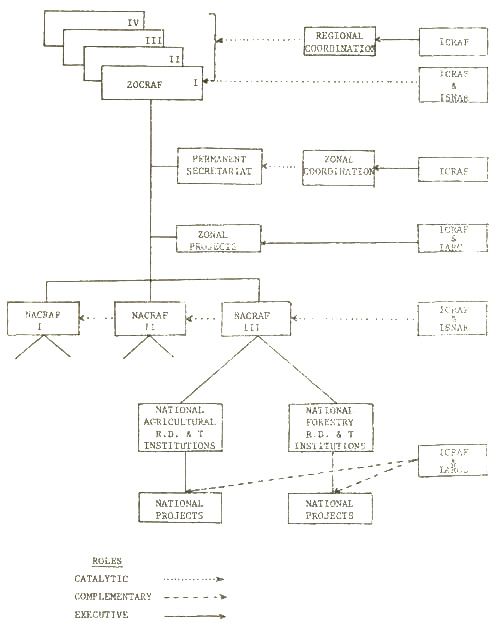
The Diagram in Fig. 1 (on page 18) shows possible organizational
relationships between national and zonal committees, permanent
secretariats, national institutions, and projects, as well as the type
of back-stopping to be provided by the. international institutions.
-
However, it is recognized that in most zones, with the possible
exception of SADCC, agreements may take considerable time for such
committees to become operational. Until such agreements are reached the
envisaged activities would, be promoted by the Network through co-ordinating
mechanisms. This notwithstanding, consensus within and between countries
on issues in the realm of functions envisaged for the committees should
be achieved before common activities are undertaken.
-
The process of setting up zonal networks (see 50) would be enhanced
by the establishment of regional and zonal co-ordination units. The main
function of a Regional Co-ordination Unit will be that of promoting
network development among countries in each of the four zones, by:
-
identifying potential network participants and leaders
among national/zonal institutions;
-
assisting such institutions in designing national/zonal
strategies and in the initial stages of programme development, from
which relevant networking issues will be derived;
-
promoting the establishment of adequate organizational
structures;
-
recruiting staff for and guiding the activities of the
corresponding zonal co-ordination units; and
-
identifying sources for external funding and mobilizing
such funds to assist zonal and national projects
-
At the technical level regional networking activities will be
assisted by an interdisciplinary team of senior and junior scientists.
The main task of this team will be to back-stop national/zonal project
teams in obtaining, collating and analyzing relevant information to
contribute improved agroforestry interventions at particular project
sites, and in developing agroforestry research methods.
-
Zonal co-ordinations would fulfil, inter alia, the following
functions:
-
channelling assistance to national institutions to
identify zonal priorities in agroforestry development, and to promote
and facilitate concerted zonal/national technology-generating projects
that overcome common landuse problems;
-
promoting zonal training to meet research needs of
member countries;
-
preparing an experts' roster drawn from institutions in
participating countries and other entities in the zone;
-
maintaining records of national and zonal agroforestry
projects to produce and distribute relevant information;
-
encouraging effective interaction between national
institutions and International Agricultural Research Centres (IARCs:
i.e., CIMMYT, ICRISAT, ILCA, IITA) or similar organizations.
-
Location-specific research projects will be executed by national,
institutions, with technical and financial assistance being provided by
the Network, as deemed necessary.
-
Projects of the problem- and component-specific type would be managed
by the Network itself, through one of the International Centres
operating in the region.
-
As mentioned (see 46), external agencies could act as catalysts,
complement national/zonal projects, and/or execute new ones. In this
context it is envisaged that such agencies could play, in principle, the
following roles:
-
ICRAF - an executive one of setting up zonal networks,
including recruiting and back-stopping coordinators and the research
team that would support regional activities;
-
ICRAF and ISNAR - a catalytic role of supporting
activities of the NACRAFs and ZOCRAFs, particularly in designing
national and zonal agroforestry development strategies;
-
ICRAF and the IARCs - a complementary one of technically
back-stopping location-specific research projects (back-stopping could
take the form of consultants, training and/or project staff, as deemed
necessary).
-
ICRAF and the IARCs - an executive one of managing zonal
problem-specific and/or component-specific research projects.
-
The diagram in
Fig. 2 (page 21) shows a possible organizational
structure to promote and support networking activities
|