An e-publication by the World Agroforestry Centre
FAIDHERBIA ALBIDA
in the West African
Semi-Arid Tropics

|
|
An e-publication by the World Agroforestry Centre |
|
FAIDHERBIA ALBIDA |
|
|
Session 4 Site Effects, Silviculture, and Symbiosis Session Papers Site Effects Variations in Root Morphology of Faidherbia albida in Relation to Soil and Agronomic Effects D.Y. Alexandre1 and S.J. Ouedraogo2 Abstract
Introduction As part of a research program focusing on the dynamics and the performance of agroforestry systems in Burkina Faso, root systems of Faidherbia albida, as well as those of other tree species, were studied at two sites. The first was the village of Watinoma, located approximately 100 km north of Ouagadougou, Burkina Faso. The second site was situated in the classified forest of Nazinon in Sissili province, 100 km south of Ouagadougou. The program began in Dec 1990. Initially, the study was limited to root systems of short bushy trees resulting from annual lopping of natural regeneration from old stumps.
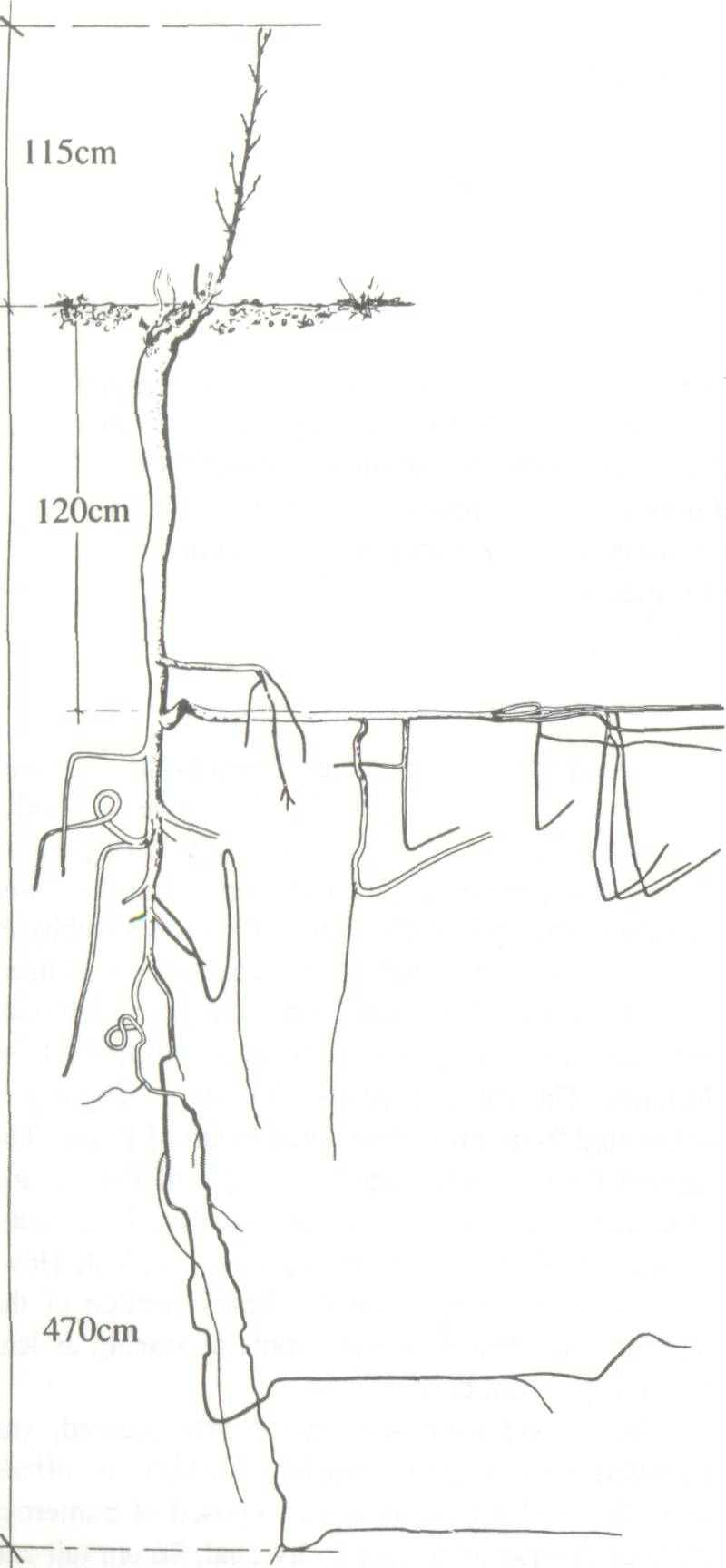
Watinoma is a Mossi village with a high population density and a pronounced topography susceptible to erosion and soil degradation. Existing vegetation types differ greatly due to variable soil conditions and the influence of the Sudano-Sahelian climate. In Watinoma, F. albida is restricted to a plain, characterized by deep sandy soils and a high water table. There are few trees between the juvenile and mature age classes (Ouedraogo and Alexandre 1991). Several root systems were studied in the three distinct zones of the village. The first zone is poorly-drained. Perennial vegetation including Mitragyna inermis, Piliostigma sp and Combretum paniculatum, mature trees, and an abundance of small shrubby F. albida are present. The root systems of two of these small trees were first examined. Both possessed multiple stems resulting from incessant cutting by local farmers. The stems averaged 30 cm in height and originated from a root found at a depth of 17 cm. The taproot abruptly terminated at a depth of 126 cm and secondary roots branched out laterally. Fine roots, indicative of water uptake, were not evident. However, on closer inspection the fleshy portion of the taproot had latent secondary roots appearing as lenticels on the root bark. The second zone was also poorly drained, and included a drainage depression. Shrubby F. albida were few and the stand was composed of numerous trees of diverse ages. One individual, 96 cm tall and 1.2 cm in basal diameter, was excavated (Fig. 1). Its taproot branched out at a depth of 120 cm to form secondary roots which attained a depth of 470 cm to a mottled, seasonally anaerobic horizon. At this depth, roots grew horizontally and abruptly changed direction (sometimes 90°) several times. No roots developed laterally towards the drainage depression. Lateral roots began to appear at a depth of 113 cm. The third zone studied in Watinoma was a transition between the sandy bottomlands and a degraded clayey hill. Here, although individuals were abundant, no adult F. albida were observed. Five multi-stemmed individuals averaging about 1 m in height were excavated to a depth of 50 cm. All emerged from a large, flat base to form multistemmed shoots over 1 m in height. There were large lateral roots and an axillary taproot. Ring counts were done on taproot sections cut 25 cm below the root collar. Twenty-three rings were counted on one root 3.7 cm in diameter (0.80 mm per ring), and 50 rings were counted on another 7.8 cm in diameter (0.78 mm per ring).
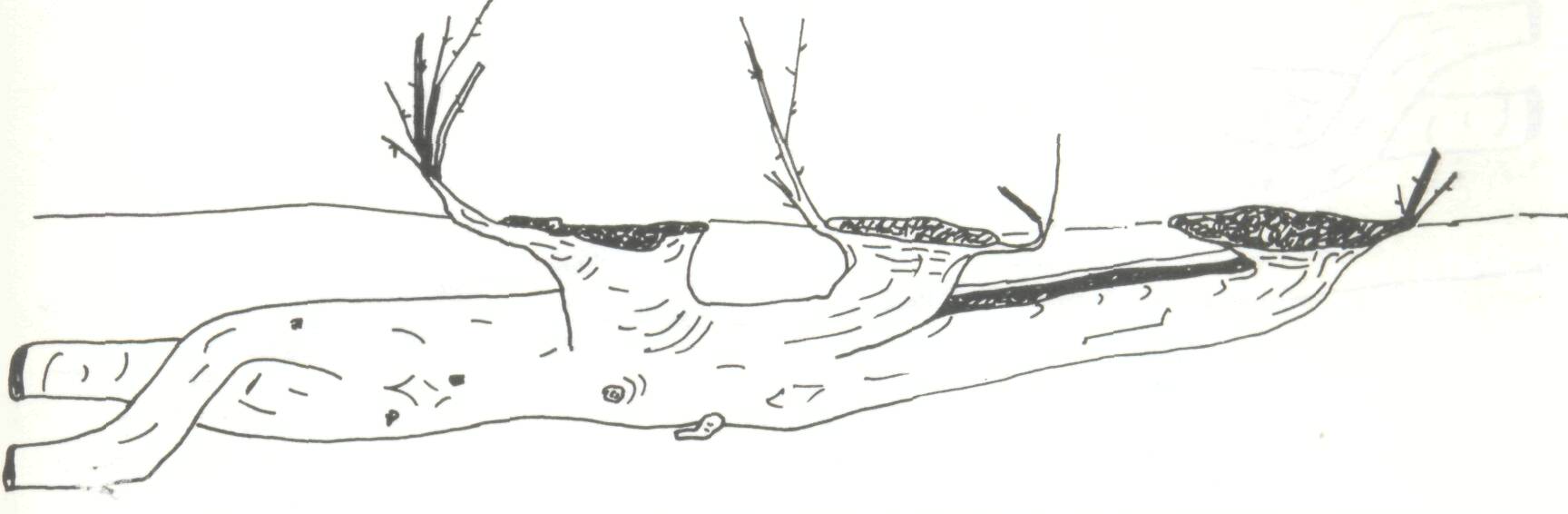
Sissili province receives more rainfall than the Watinoma area, but is much less populated because of extremely poor soils. Two principal ethnic groups, the Mossi in the east and the Gurunsi in the west, inhabit this area. Only village lands of the Gurunsi possess significant F. albida parks, which contain a number of huge and very old individuals. In Looru village, the circumference of one adult F. albida was 5.6 m. The crown of another had an average diameter of 35 m. The sandy soils, rich in organic matter at the surface, were clayey (reddish) and compact at a depth of 1 m. F. albida trees were affected by drought. The water level in local wells was 32 m. These old trees were often surrounded by numerous drought-stressed, shrubby F. albida. In the Rakaye Yarse village, shrubby F. albida formed numerous thickets which were frequently cut back. Shoot heights averaged over 2 m, and sometimes grew from stumps exceeding 1 m in diameter. Root systems did not surpass 32 cm in depth. At Bum village, a large, recently windthrown F. albida exhibited a shallow root system with no trace of a taproot. These shrubby thickets are very old, and village elders have always known them to exist. There has been a relentless struggle between the rural population which cuts back the regrowth, and the trees, which resprout. Farmers who were interviewed complained that F. albida "takes up space" and that the species "is not wind-resistant". In the Ku village, an old, large-diameter F. albida tree overlooked the landscape. The owner of this tree claimed to have high crop yields under it. One excavated bushy tree downhill from there had a taproot which penetrated the yellowish and very compacted upper horizon. Sixty rings were counted on a cross section of one root 2.8 cm in diameter (0.2 mm per ring, four times less than the ratio found in Watinoma). Most of the trees we excavated were in Rakaye Yarse. Twenty of these rooted only to a shallow depth, but three others rooted to 210 cm. Figure 2 is typical of the peculiar morphology of F. albida existing in this village. Stems emerged from a large horzontal root which had secondary roots at one end; these were atrophied on the upper side. At the other end, there was a partially decayed stump which had shoots growing along its periphery. The specimen we excavated had shoots growing from three stumps. Such horizontal roots and their associated stumps grew close together and could be confused with a root sucker system. Some roots successfully penetrated the clayey horizon. Their pathways were erratic, veering both horizontally and vertically in an apparently random manner. At 210 cm, a small root (3 cm in diameter) was uncovered which probably continued to greater depths.
These initial observations revealed the morphological plasticity of F. albida taproot development under different soil conditions. In Watinoma, a taproot hit an indiscernable barrier at a depth of 126 cm. In Bum, as in Rakaye Yarse, the root systems were restricted to the upper soil horizons. In Ku, roots penetrated compact soils but with much difficulty. The presence of latent lateral roots reflect the great environmental flexibility of F. albida. F. albida takes up water from great depths and can also send out shallow lateral roots if moisture conditions in the upper horizons are favorable. The presence of F. albida has been frequently linked to the history of the farmer's use of the land. It would be interesting to know whether the abundance of F. albida in the Gurunsi villages indicates a more positive attitude of the local people towards the species vis-a-vis the Mossi or whether this is due to the existence of better soils. F. albida has two habitats (Wickens 1969): a 'nat-ural' one in hydromorphic lowlands, where the spe-cies is characteristically shallow-rooted, and the other is linked to the activities of farmers on sandy soils overlying accessible but deeper water tables. Only in the second habitat has F. albida been associated with its celebrated effects on crop yield. It is possible that F. albida could benefit associated crops by taking up otherwise inaccessible water from a great depth and making it available to crops by releasing it from its taproot (Alexandre 1990). Measurements by Dancette and Poulain (1968) in Senegal showed that soil moisture at 1.2-4 m beneath F. albida was much higher than away from the tree at the end of the dry season. If this hypothesis is true, F. albida would have little or no positive impact on growth of associated crops on soils where taproot development is inhibited or delayed. Although these observations are preliminary, they should indicate the limitation of F. albida's extension. Its establishment where soil conditions do not favor taproot development may not result in beneficial effects.
Alexandre, D.Y. 1990. Importance quantitative et qualitative des échanges d'eau entre racines d'espèces differentes. Presented at the Séminaire sur la physiologie des ligneux en zone aride, 27 mars-7 avril 1990, Nancy, France. 3 pp. Dancette, G., and Poulain, J.F. 1968. Influence de l'Acacia albida sur les facteurs pédoclimatiques et les rendements des cultures. IRAT/CNRA Nouvelle contribution. Paris, France: Institut de recherches agronomiques tropicales et des cultures vivrières/ Centre national de recherches agronomiques. 45 pp. Ouédraogo, J.S., and Alexandre, D.Y. 1991. Place de Faidherbia albida dans le terroir de Watinoma (Burkina Faso). Paris, France: Institut français de recherche scientifique pour le développement en coopération. (Limited distribution.) Wickens, G.E. 1969. A study of Acacia albida Del. (Mimosoideae). Kew Bulletin 23(2):181-202.
1 Laboratoire d'ecologie, Institut francais de recherche scientifique pour le developpement en cooperation (ORSTOM), Ouagadougou, Burkina Faso. 2 Institut de recherche en biologie et ecologie tropicale (IRBET), 03 B.P. 7047, Ouagadougou, Burkina Faso. Alexandre, D.Y., and Ouedraogo, S.J. 1992. Variations in root morphology of Faidherbia albida in relation to soil and agronomic effects. Pages 107-110 in Faidherbia albida in the West African semi-arid tropics: proceedings of a workshop. 22-26 Apr 1991, Niamey, Niger (Vandenbeldt, R.J., ed.). Patancheru, A.P. 502 324, India: International Crops Research Institute for the Semi-Arid Tropics: and Nairobi. Kenya: International Centre for Research in Agroforestry. |