An e-publication by the World Agroforestry Centre
FAIDHERBIA ALBIDA
in the West African
Semi-Arid Tropics

|
|
An e-publication by the World Agroforestry Centre |
|
FAIDHERBIA ALBIDA |
|
|
Session 4 Site Effects, Silviculture, and Symbiosis Session Papers Site Effects The Effect of Faidherbia albida on Soil Properties in a Semi-Arid Environment in Morogoro, Tanzania J. Okorio1 Abstract
Introduction Although the great benefits of Faidherbia albida to farmers in the Sudano-Sahelian zone of Africa is well known, very little information exists in the eastern African region regarding the performance of F. albida on crop lands. This paper presents results from a semi-arid environment in Tanzania where relatively young F. albida trees were assessed for their effects on soil nutrients when grown in association with maize and beans or as a monocrop.
Site Description The experimental site is at Mafiga, Morogoro (37°38'E and 6°50'S) which is 520 m above sea level. The area lies on a flood plain and is almost flat, with a slope of less than 5%. The soils are sandy loams, with pH (water) of 6.5, organic carbon content of 0.7%, total nitrogen content of 0.04%, available phosphorus content of 8.8 ppm, and exchangeable bases of 10.5 meq100 g-1 (Kesseba et al. 1972). The mean annual rainfall is about 860 mm, falling between December and May. Monthly mean temperatures vary between 19 and 34ºC, while mean monthly relative humidity varies from 40% to 70% (FAO 1984). Experimental Design Container-grown seedlings of F. albida were planted in Feb 1980 in a plowed and harrowed field that had been fallow for several years (Maghembe and Redhead 1982). The design was a split plot, replicated 4 times, with food crops (maize or beans) and a non crop control forming the three main plots. The 4 sub-plot treatments were without trees or with trees spaced at 4 x 4, 5 x 5, and 6 x 6 m. The subplots measured 30 x 30 m and contained 0, 56, 36, or 25 trees. Maize (Zea mays, Ilonga composite) and beans (Phaseolus vulgaris, Canadian Wonder) were planted for seven consecutive seasons. Fertilizer was applied each season at a rate of 400 kg ha-1 ammonium sulfate and 200 kg ha-1 triple superphosphate for maize and 200 kg ha-1 ammonium sulfate and 200 kg ha-1 triple superphosphate for beans. All plots were clean weeded by harrowing using a tractor and supplemented by hand hoeing. Soil Samples Soil samples were collected using a soil auger from five sampling points in each of the subplots without trees and from the subplots with trees spaced at 5 x 5 m (400 trees ha-1) of each replication. At each sampling point, soil samples were taken at three soil depths (0-15, 15-30, and 30-60 cm). Samples were bulked for each subplot, and then subsampled. Chemical analyses were carried out to determine total nitrogen (Bremmer 1965), available phosphorus (Bray and Kurtz 1945), exchangeable potassium, calcium, magnesium, and sodium. In addition, soil pH (1:2 soil to water paste) and organic carbon (Allison 1965) were determined. Statistical Analysis of Data Analysis of variance for the split-plot design was performed on the nutrient content of the soil to test differences between the treatments. Duncan's multiple range test was used to separate significant means.
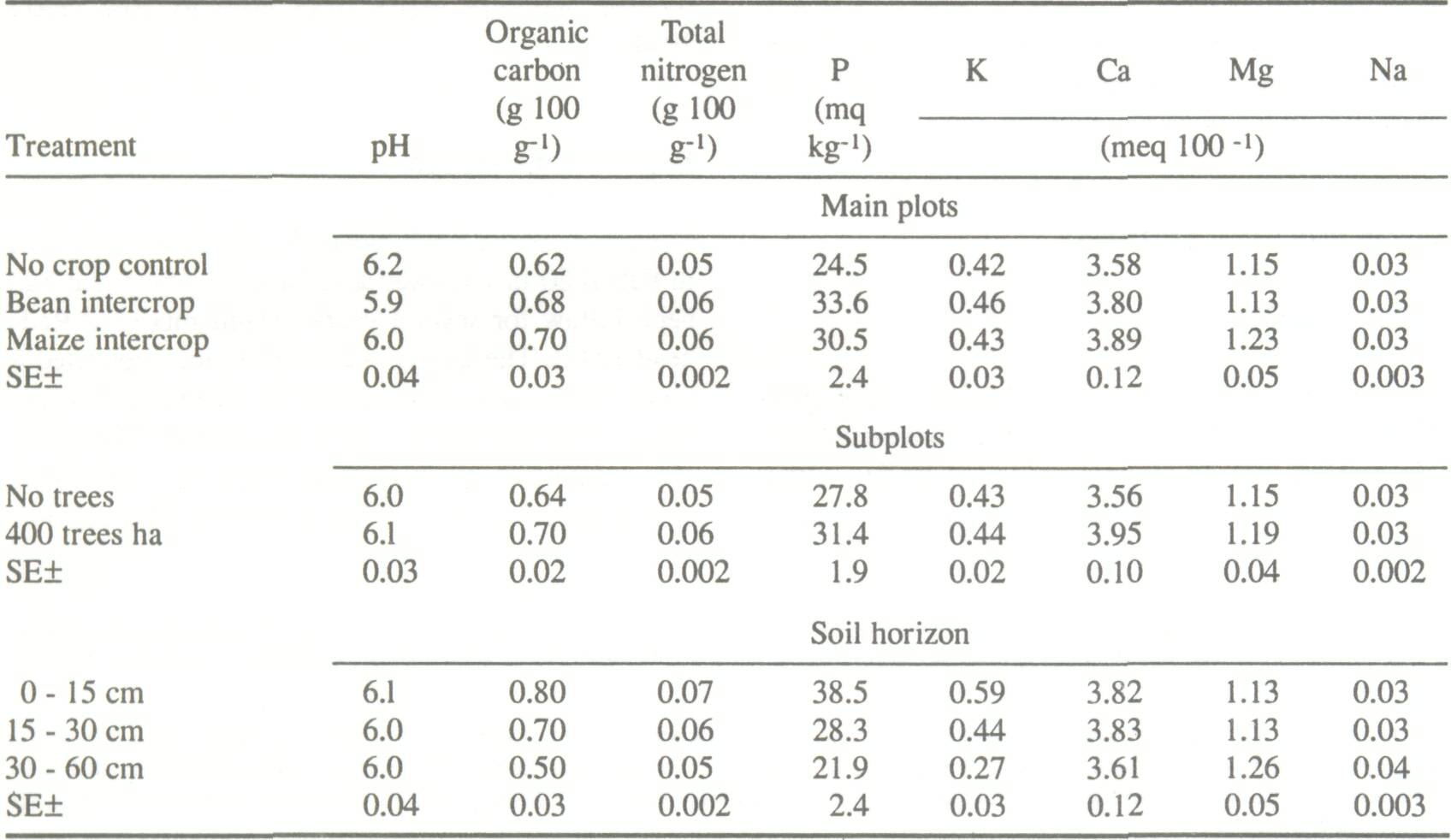
Soil pH and the concentrations of organic carbon, total nitrogen, phosphorus, and potassium decreased down the soil profile, while those of magnesium and sodium increased (Table 1). The concentration of calcium remained relatively constant throughout the soil profile. Intercropping with beans or maize significantly increased the levels of soil calcium, phosphorus, total nitrogen, and organic carbon but lowered soil pH. It did not seem to affect the levels of potassium, magnesium, and sodium. Plots with F. albida trees had significantly higher soil pH, organic carbon, total nitrogen, and calcium, but phosphorus, potassium, magnesium, and sodium were not affected in these plots. There were no significant interaction effects between the presence or absence of trees and intercropping, indicating no link between the two on the soil chemical differences.
However, at the Kenyan Coast, Jama and Getahun (in press) reported no significant differences in the levels of soil nutrients between experimental areas with trees and without trees. They ascribed this to a possible 'lock-up' of these nutrients in the tree bio-mass in high density stands. The absence of any significant influence of F. albida trees on soil at the Kenyan Coast could be attributed to the young age of the trees (4 years). Most of the other studies cited involved mature trees. This could explain why in this study involving 6-year old trees, most soil elements that are usually reported as significantly higher in the presence of F. albida trees were not. It could also be the reason why the yields of maize and beans that had been intercropped with the trees were not significantly different from those in areas without the trees (Okorio and Maghembe 1991). Poschen (1986) estimates that F. albida trees need 20-40 years to grow to a size when they can influence the soil nutrients and hence significantly improve yields of underplanted crops. If so, this means that the present trial needs to be maintained and monitored for some time to come before any firm conclusions and recommendations can be made. The next assessment on the influence of the trees on the soil nutrients should also include all the tree densities in the trial (278, 400, and 625 trees ha-1) because the present assessment only considered medium tree density stands (400 trees ha-1). It is possible that a different picture could have emerged if the other tree density stands had also been assessed. Acknowledgments. This study is part of a large agroforestry research project funded by the Norwegian Agency for International Development (NORAD). This work is a portion of the author's dissertation accepted in partial fulfilment for the M.Sc. Forestry degree at Sokoine University of Agriculture, Morogoro, funded by NORAD. Secretarial services rendered by E.M. Tarushoke during the preparation of the manuscript are highly appreciated.
Alexander, M.J. 1989. The effect of Acacia albida on tin-mine spoil and their possible use in reclamation. Landscape and Urban Planning 17:61-71. Allison, L.E. 1965. Organic carbon by the Walkley-Black method. Pages 1372-1376 in Methods of soil analysis. Part II. Chemical and microbiological properties (Black, C.A., ed.). Madison, USA: American Society of Agronomy. Bray, R.H., and Kurtz, L.T. 1945. Determination of the total organic and available forms of phosphorus. Soil Science 59:39-45. Bremmer, J.M. 1965. Total nitrogen by the macro-Kjeldhal method. Pages 1149-1164 in Methods of soil analysis. II. Chemical and microbiological properties (Black, C.A., ed.). Madison, USA: American Society of Agronomy. Pages 1149-1164. Charreau, C., and Vidal, P. 1965. Influence de l'Acacia albida Del. sur le sol: nutrition minérale at rendements des mils Pennisetum au Sénégal. Agronomie Tropicale 6-7:600-626. Dancette, C., and Poulain, J.P. 1969. Influence of Acacia albida on pedoclimatic factors and crop yields. African Soils 14:143-184. FAO. 1984. Agroclimatological data for Africa. II. Countries south of the equator. Plant production and protection series, no. 22. Rome, Italy: Food and Agricultural Organization of the United Nations. 250 pp. Jama, B., and A. Getahun. (In press.) Intercropping Acacia albida with maize and green gram at Mtwapa, Coast province, Kenya. Agroforestry Systems. Kesseba, A., J.R. Pitblado, and Uriyo, A.P. 1972. Trends in soil classification in Tanzania. I. The experimental use of the 7th approximation. Journal of Soil Science 23:235-247. Maghembe, J.A., and Redhead, J.F. 1982. Agroforestry: Preliminary results—intercropping Acacia, Eucalyptus and with Leucaena maize and beans. Pages 43-49 in Intercropping in semi-arid areas (Keswani, C.L., and Ndunguru, B.J. eds.). Canada: International Development Research Centre. Okorio J., and Maghembe, J.A. 1991. The growth and yield of F. albida intercropped with maize (Zea mays) and beans (Phaseolus vulgaris) in Morogoro, Tanzania. Paper presented at the Regional Conference on Agroforestry Research and Development in the Mi-ombo Ecozone of Southern Africa, 16-21 Jun 1991, Blanytre, Malawi. Poschen, P. 1986. An evaluation of the Acacia albida-based agroforestry practices in the Hararghe highlands of eastern Ethiopia. Agroforestry Systems 4:129-143. Saka, A.R. and Bunderson, W.T. 1989. The potential of Acacia albida and Leucaena leucocephala for smallholder crop production systems in Malawi. Pages 150-161 in Trees for Development in Sub-Saharan Africa: proceedings of the IFS Regional Seminar, 20-25 Feb 1989, Nairobi, Kenya. Nairobi, Kenya: International Centre for Research in Agro-forestry.
1 International Centre for Research in Agroforestry (1CRAF), Agroforestry Research Network for Africa (AFRENA), Project, P.O. Box 311, Kabale, Uganda. Okorio, J. 1992. The effect of Faidherbia albida on soil properties in a semi-arid environment in Morogoro, Tanzania. Pages 117-120 in Faidherbia albida in the West African semi-arid tropics: proceedings of a workshop, 22-26 Apr 1991, Niamey, Niger (Vandenbeldt, R.J., ed.). Patancheru, A.P. 502 324, India: International Crops Research Institute for the Semi-Arid Tropics; and Nairobi, Kenya: International Centre for Research in Agroforestry. |