An e-publication by the World Agroforestry Centre
FAIDHERBIA ALBIDA
in the West African
Semi-Arid Tropics

|
|
An e-publication by the World Agroforestry Centre |
|
FAIDHERBIA ALBIDA |
|
|
Session 4 Site Effects, Silviculture, and Symbiosis Session Papers Silviculture Regeneration of Acacia albida with Direct Seeding S.A.N. Samba1 Abstract
Introduction Throughout the northwestern part of the Groundnut Basin, Senegal, Acacia albida parks consist predominantly of mature trees. However, natural regeneration beneath them is virtually non-existent. In 1986, the DRPF/ISRA, Senegal, established a direct seeding study to determine if this inexpensive method could be used to regenerate this regionally important species (Cazet 1987).
Thienaba, the site chosen for the regeneration trial was located in the Sahelian zone of Senegal characterized by a 9-month dry season and a 3-month rainy season. Annual precipitation ranges between 400 and 500 mm. The soils were sandy (90-94%) and dominated by fine sands (54-62%). The clay plus silt fraction was less than 5%. Organic matter content of the soil was estimated at 0.2% and available soil water was approximately 4%.
Seeds used in the trial were collected in a region with similar ecological conditions as those of Thienaba. Seeds used in the nursery were pretreated with concentrated sulfuric acid for 30 minutes. Following pregermination in an incubator (95% germination), seeds were then sown in pots on 28 Apr 1986. Seeds used for direct seeding were also pretreated with sulfuric acid. In preparation for planting and seeding, 50 x 50 x 60 cm holes were dug on the site, treated with dieldren, then backfilled. Outplanting was done on 11 Jul 1986 following a rain of 22 mm. At the time of planting, the bottoms of pots were cut to remove the coiled roots of the 11-week old plants. A 21-day drought period followed the planting date, requiring resowing of direct seeding plots on 5 Aug because of high mortality. The design was a randomized complete block design. Each of the 4 blocks of 2 treatments (direct seeding or potted seedlings) formed plots of 24 (6 x 4) plants. Potted seedlings were planted at 4 x 4 m whereas seed pockets (each seeded with 3 pregerminated seeds) were spaced at 2 x 4 m. Plots were weeded in August, September, and October. Survival rate, plant height, diameter at the root collar, dry shoot mass, taproot length, maximum diameter of the taproot, total length of roots, and dry root mass were recorded. Samples for weighing were dried at 105°C to constant weight.
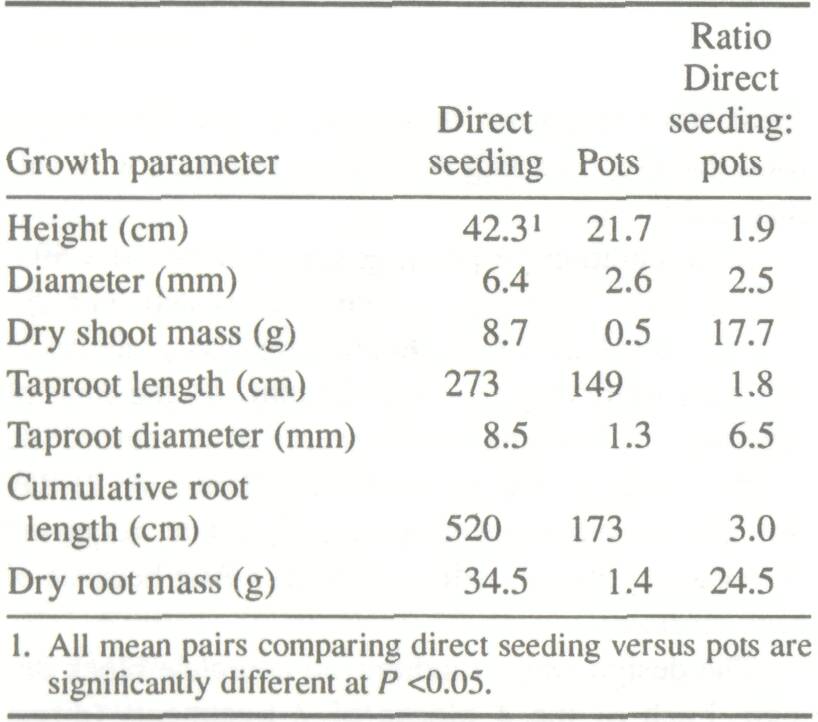
On 29 Nov, 49% of the hills had 3 seedlings, 33% had 2 seedlings, and 15% had 1 seedling. Only 3% of the hills had no emergence. Thus, the survival rate of the total number of seeds planted was 76% at 3.8 months. No mortality was observed afterwards. Survival of seedlings grown in pots decreased from 79% at 3 months to 66% at 6.5 months. Comparison of juvenile growth parameters between the two techniques are shown in Table 1. `
For all the parameters studied, direct seeding gave the best results. Favorable conditions at the time of seeding, however, were critical for the success of this technique. Besides the clear superiority of direct seeding over potted seedlings in terms of growth (Table 1), survival rates of direct-seeded plants were much higher. At month 6, direct seeding of three pregerminated seeds per hill had a 48% higher survival rate than potted seedlings raised 2.5 months in the nursery. Based on these results, direct seeding can be recommended provided that seeding is done when the soil is moist to a depth of over 50 cm. Weeds must be suppressed and the site must be adequately preparated to encourage rapid taproot development.
Cazet, M. 1987. La régénération artificielle de Faidherbia albida en zone sahélienne. Plantation ou semis direct? Premiers résultats de l'expérimentation conduite à Thiénaba (Sénégal) en 1986. Dakar, Senegal: Direction des recherches sur les productions forestières. 49 pp. (Limited distribution.)
1 Direction des recherches sur les productions forestieres (DRPF)/Institut senegalais de recherches agricoles (ISRA), B.P. 2312, Dakar, Senegal. Samba, S.A.N. 1992. Regeneration a! Acacia albida with direct seeding. Pages 139-140 in Faidherbia albida in the West African semi-arid tropics: proceedings of a workshop. 22-26 Apr 1991, Niamey, Niger (Vandenbeldt, R.J.. ed.). Patancheru. A.P. 502 .124, India: International Crops Research Institute for the Semi-Arid Tropics: and Nairobi, Kenya: International Centre for Research in Agroforestry. |