An e-publication by the World Agroforestry Centre
FAIDHERBIA ALBIDA
in the West African
Semi-Arid Tropics

|
|
An e-publication by the World Agroforestry Centre |
|
FAIDHERBIA ALBIDA |
|
|
Session 3 Genetics, Provenance Trials, and Vegetative Propagation Session Papers Generics Morphological Variability of Pods of Four Faidherbia albida Provenances in Senegal M.H. Chevalier1, M. Sogna2, A.S. Sarr2, and P. Danthu1 Abstract
Introduction Over the last decade, management of tree genetic resources in Senegal has diminished. A number of recent projects have begun the task of conserving, protecting, and improving these resources (FAO 1980). Faidherbia albida, due to its value in Senegalese agriculture, was one of the priority species chosen for the program (FAO 1980; Louppe 1989). Diverse studies have since been carried out by international organizations throughout the range of this species. The Direction des recherches sur les productions forestieres (DRPF)/Institut sénégalais de recherches agricoles (ISRA) has implemented a pro-gram to collect and evaluate genetic resources of F. albida in Senegal. This study focused on the biometry of pods. Prior work has shown significant variability in pod form and size of different acacia species as well as of F. albida (Nongonierma 1977).
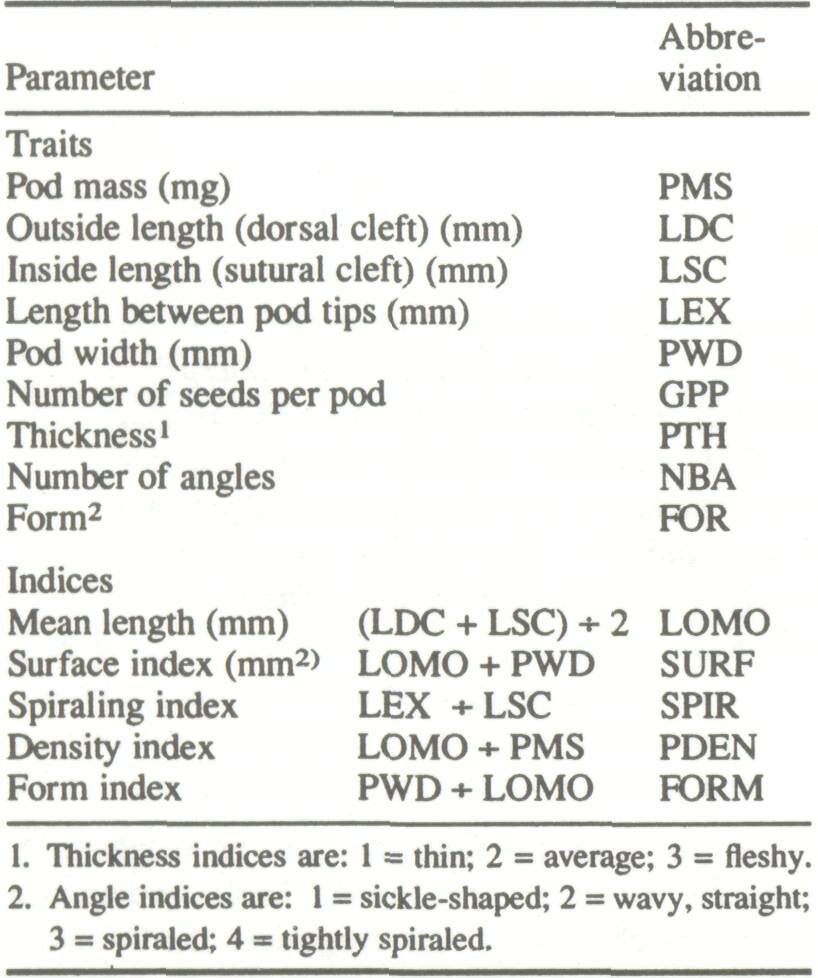
In 1990, 7 provenances of F. albida from northern to southern Senegal were collected. Seeds and pods were used from the following four provenances by separate progenies: the Merina Dakar provenance from northern Senegal (28 progenies); the Ovadiour provenance from the Groundnut Basin (30 progenies); the Kagnobon provenance from Casamance (20 progenies); and the Bode provenance from Casa-mance (22 progenies). One hundred progenies in total and ten pods per progeny were studied. Nine traits were measured and four indices were calculated from these (Table 1). Data were interpreted using analysis of variance, principal components and correspondence analysis, and discriminant factor analysis.
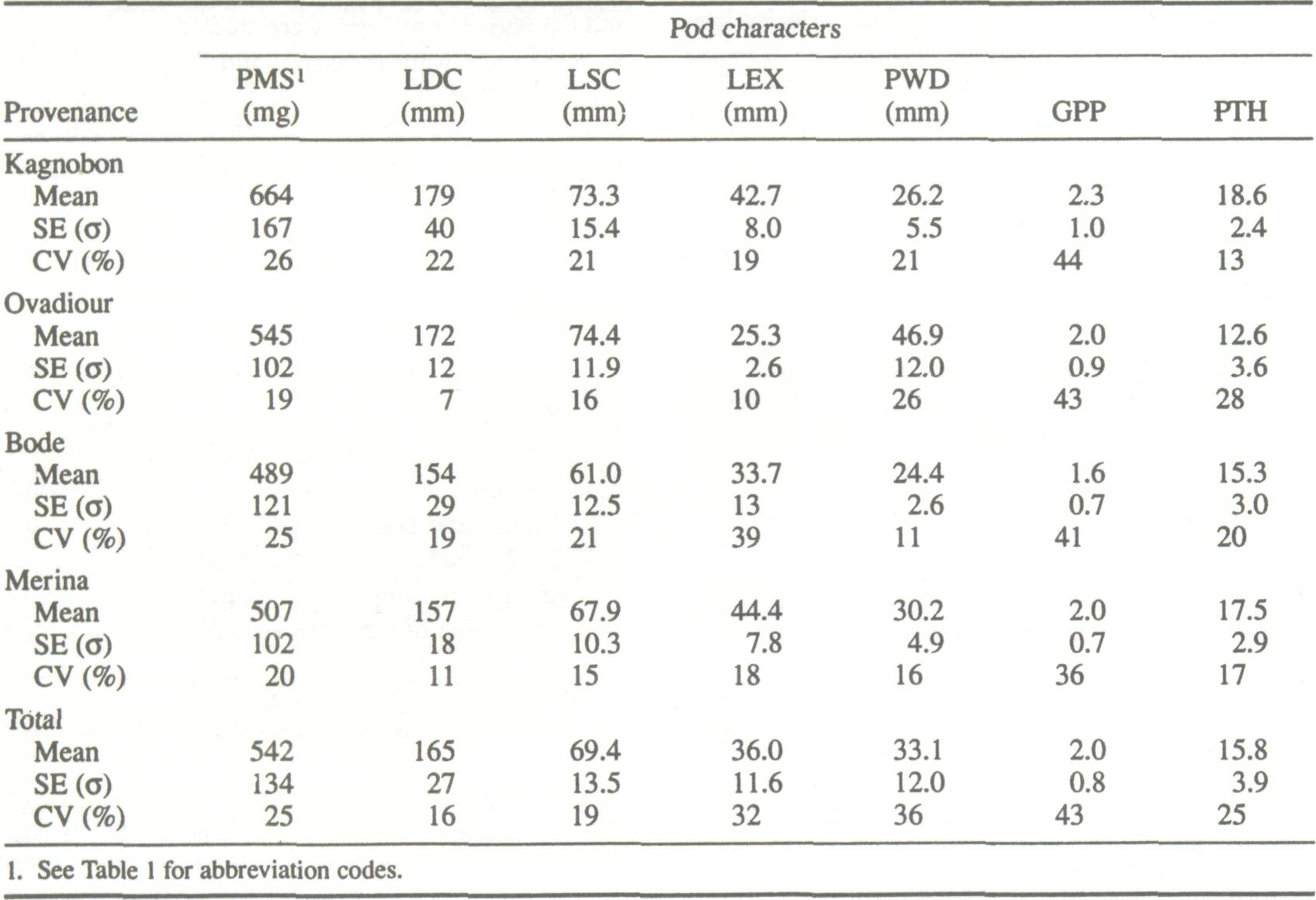
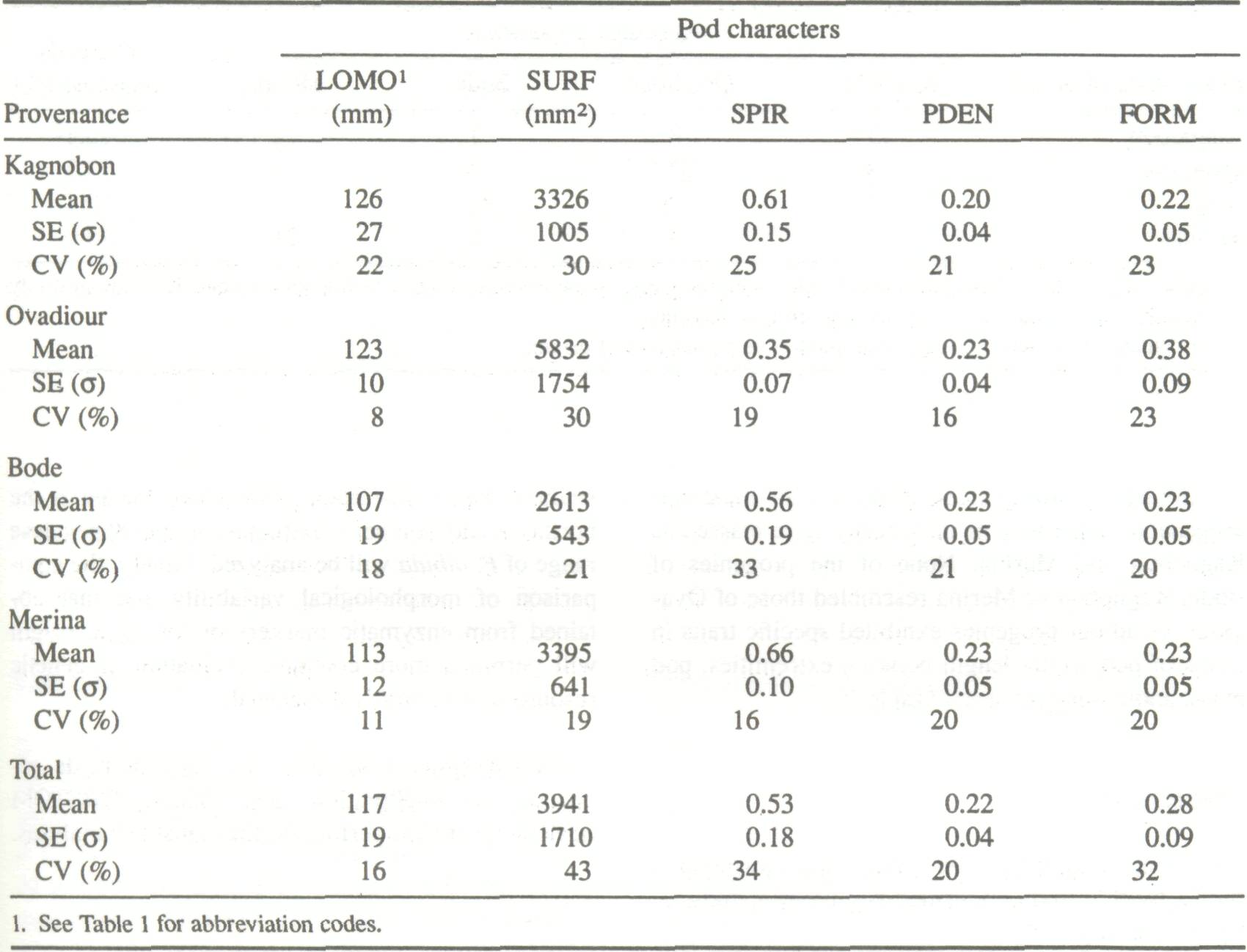
Pod size for all the provenances was extremely variable. This was due to large differences in outside pod length (112-270 mm) inside pod length (44-112 mm), distance between pod tips (12-71 mm), pod width (17-67 mm), and pod mass (292-989 mg). Pods contained 7-23 seeds. Among the important indices calculated, the spiraling index ranged from 0.17-0.90 with an average of 0.53, the surface area index from1613-9502 mm2 and the ratio of width to average length from 0.13-0.54. Analysis of variance done showed a significant provenance effect for all the variables with the exception of density index and number of angles (Tables 2 and 3). Differences between provenances were highly significant for length between pod tips, pod width, number of seeds per pod, and surface area index. Certain variables characterize each provenance. For example, the Ovadiour provenance had the largest and straightest pods among the provenances studied as well as the fewest number of seeds per pod.
Principal Components and Correspondence Analysis Principal components analysis is a descriptive statistical method which is often used to examine the interrelationships among several variables. The first principal component defines a new variable that explains as much as possible of the variability in the original data. The second principal component is made to be independent of the first and in such a way that it explains as much as possible of the variability that remains. Often the first two components explain a large proportion of the total variability and the data are then usually displayed in a two dimensional plot. In this study a principal component analysis was conducted on both the traits measured and on the derived indices. The first two axes on the measured traits explained 62.1% of the variation. A display of the data showed that the progenies of Ovadiour could be distinguished from the remaining progenies. A distinguishable contrast also existed between the Bode and Kagnobon progenies. The results from an analysis of the derived variables did not give results that were as clear as with the original variables.
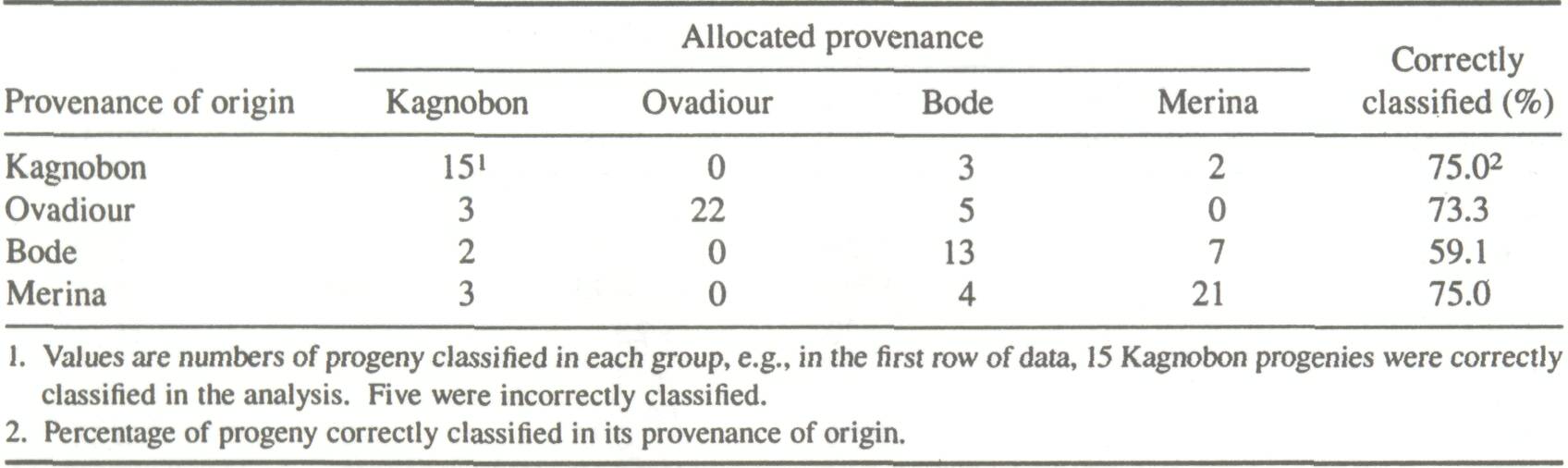
Discriminant Factorial Analysis In order to determine the relationship of progenies to their provenances of origin and to test the provenance effect determined by the analyses of variances, a discriminant factorial analysis was done on the traits measured. Only 71% of the progenies were definitely classed in their provenance of origin (Table 4).
The great variability in F. albida pod morphology shown by this study confirmed results of a study by Nongonierma (1977). The following traits revealed the greatest diversity of F. albida pods collected throughout the Senegalese range of the species: inside and outside pod length between pod tips; pod width; pod mass, and number of seeds per pod. The different form indices (qualitative or calculated variables) and number of angles, provided little benefit to the analysis. In any case, it was very difficult, at the time of measuring, to class the often variable and complex forms of the observed pods. Intra- and interprovenance variability were of the same order; therefore, it was very difficult to characterize provenances according to their geographic origin. Nevertheless, pod size of the Bode provenance contrasted with that of the Kagnobon provenance. Pods of the Ovadiour provenance were characteristically stubby. To verify if this particular trait of the Ovadiour provenance is unique to its location, three other provenances in the same region will be studied. Also, pods from provenances located at the northern and southern extremes of the Senegalese range of F. albida will be analyzed. Finally, the comparison of morphological variability and that obtained from enzymatic markers of the same origin will permit a more complete evaluation of genetic resources of F. albida in Senegal. Acknowledgment. We thank the Laboratoire de génétique et amelioration des plantes, ORSTOM (Dakar) where we performed the statistical analyses.
FAO. 1980. Ressources génétiques d'essences arborées des zones arides et semi-arides. FAO/IBPGR Project. Rome, Italy: Food and Agriculture Organization of the United Nations/International Board for Plant Genetic Resources. 130 pp. Louppe, D. 1989. Influence de Faidherbia albida sur le rendement agricole-nouvelle contribution. Presented at the Workshop on 'Foret: Environnement et Developpement,' Dakar, Senegal, 22-26 May 1989. Dakar, Senegal: Institut des sciences de l'environne-ment/University of Dakar. Nongonierma, A. 1977. Contribution à l'étude biosystématique du genre Acacia Miller en Afrique occidentale. V. Caractères biométriques des fruits. Bulletin IFAN 39:695-787.
1 Centre technique forestier tropical (CTFT)/Institut sénégalais de recherches agricoles (ISRA), B.P. 2312, Dakar, Senegal. 2 Direction des recherches sur les productions forestieres (DRPF)/Institut sénégalais de recherches agricoles (ISRA), B.P. 2312, Dakar, Senegal. Chevalier, M.H., Sogna, M., Sarr, A.S., and Danthu, P. 1992. Morphological variability of pods of four Faidherbia albida provenances in Senegal. Pages 67-70 in Faidherbia albida in the West African semi-arid tropics: proceedings of a workshop, 22-26 Apr 1991, Niamey, Niger (Vandenbeldt, R.J., ed.). Patancheru, A.P. S02 324, India: International Crops Research Institute for the Semi-Arid Tropics; and Nairobi, Kenya: International Centre for Research in Agroforestry. |