An e-publication by the World Agroforestry Centre
FAIDHERBIA ALBIDA
in the West African
Semi-Arid Tropics

|
|
An e-publication by the World Agroforestry Centre |
|
FAIDHERBIA ALBIDA |
|
|
Session 5 Social and Development Issues Session Papers Faidherbia albida: A Witness of Agrarian Transformation J.P. Hervouet1 Abstract
Introduction An excerpt from a conversation held with Tengsoba of Niaogho, Burkina Faso (Hervouët 1978) is given below: "When the Bissa arrived in this region, they found no one. There was nothing but bush which was opened for clearings. In the beginning, their homesteads were surrounded by Parkia africana; but since the Bissa had many cattle and the Parkia africana does not prefer manured soil, they were gradually replaced by Faidherbia albida. F. albida demarcated field borders and the Bissa no longer needed to farm in the bush. All the village children learned to raise-in the sense of raising a child F. albida by pruning it. After the white man's arrival, land had to be cultivated longer and agricultural lands expanded. Then the F. albida began to perish, and it was cut down to make mortars and pestles, for the white man was prohibiting the cutting of Khaya senegalensis and we didn't have money to pay for permits. At this time, many people left, and if they all came back today, the country would not have the resources to support them, even with all the fields that have been cleared in the bush." Two years have passed since the study team visited the land and farmers of Niaogho. Tengsoba's description of land use as it existed when he was young was as a prelude to an in-depth description of F. albida-its ecology and its contribution to the soils and to agricultural and animal production.
Despite their importance, numbers, diversity, and vastness in range, descriptions of F. albida parks are scarce in scientific literature. Before Pélissier (1953), agronomic and geographic references to the intensive agrarian system generally associated with F. albida parks were rare. A few years after Pélissier, Savonnet (1959) also described 'a perfected farming system practiced by the Bwaba-Bobo-Oulé of the Houndé region'. He did not extend those observations to the numerous other agropastoral people of this Sudanian zone. Following that, studies done in Bambey, Senegal focused on the impact of F. albida on soil and crop yields (Charreau and Vidal 1965; Pélissier 1966). Despite the ubiquity of F. albida in western Africa, available geographic and agricultural literature gives the impression that the adoption of F. albida by the rural population is a rare phenomenon in Sudanian and southern Sahelian Africa. Rather, it would seen that the norm consists of extensive farming systems where most crop production is carried out in temporary fields cleared in the bush. One cannot count the number of publications on village lands, even in villages where it predominates, in which authors ignored this species. Careful examination of rural land use contradicts the idea of ignorance or disinterest in F. albida on the part of farmers. Most village lands in Burkina Faso are occupied by at least a few F. albida.
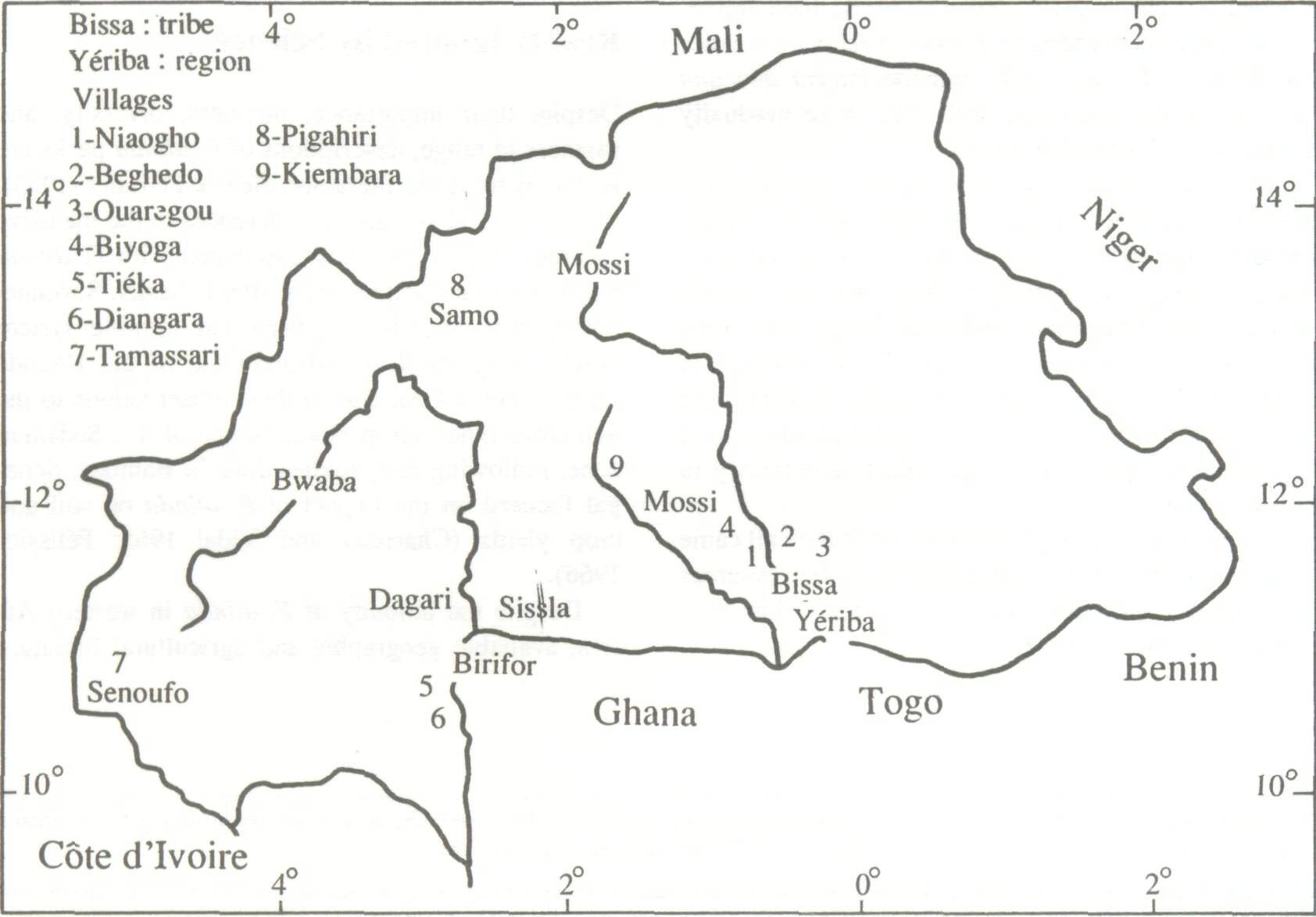
When the Niaogho chief was speaking of F. albida and its benefits, decades had already passed since parks on Bissa land were tended. The system was in a state of decline. Except for one dense grove and a few isolated trees, no F. albida remained. The abandonment of F. albida parks in Burkina Faso occurred over the past 20 years between the White and Red Volta Rivers (now called the Nakambé and Nazinon), on Birifor and Dagari lands, on Bwaba lands to the west and to the north of Bobo Dioulasso, on Senoufou lands between Mali and the Cote d'Ivoire, on Sissala lands neighboring Ghana, and on Samo lands bordering the Sourou River (Fig. 1). The Samo abundonment occurred with particular suddenness. In 1975, Samo fields were grouped around the villages, shaded by a dense F. albida park manured by Fulani cattle and located near a natural wood and wildlife reserve almost untouched by farming. A neighboring Mossi region, where bush-based agriculture played an essential role in the production system, contrasted with the Samo system. The following year, the Samo Cleared fields in the bush following the example of the neighboring Mossi, and parklands were practically abandoned. The trees were lopped heavily, a sign of their impending doom. All such transitions have not occurred with this suddenness, and it is not uncommon to see parks abandoned by farmers for 2-3 years, and then reculti-vated. This occurred in a Sissala region of Burkina Faso between 1978 and 1980, and in the Bwaba area between Boromo and Bobo Dioulasso. These actions may have resulted from crop pest invasions, and should not be confused with true abandonment of parks and practices which lead to the decline, or even disappearance, of the trees.
With few exceptions, regardless of the ethnic group or population density, F. albida parks do not exist in new villages or recent settlements. One exception was noted by Benoît (1973) who noted that recent homesteads in the village of Daboura, Burkina Faso were built on an F. albida park, whereas the oldest parts of the village existed outside the park. This was because the village had taken part in a 1916 revolt and was relocated outside the park after its defeat. Similarly parks are sometimes found where old but now abandoned villages exist. However, they are never found on more recent village sites. For example near Yeriba, along the White Volta, 25 Bissa villages were settled during from 1900-40 (Hervouet 1978). Although F. albida does not occur in these village lands, it was an integral part of the agricultural practices in the original villages the settlers emigrated from. Thus, a long time has passed since F. albida parks were cropped, established or regenerated. It is also apparent that, because of the diverse ethnic groups involved, this move toward extensive agricultural techniques did not happen simultaneously.
Whenever African agriculture is described, it is often argued that intensive systems are the outcome of outside constraints, whether due to insecurity or demographic pressure. F. albida parks are found in both highly populated (60 to up to 150 persons km-2) and sparsely populated areas in Burkina Faso. As previously mentioned, farmlands of Niaogho were once surrounded by a vast, forested 'no man's land'. Towards the west, the tree savanna stretches over 30 km to the first Mossi village in the canton of Manga. The same contrast between the bush and densely populated settlements is found among a number of other peoples including the Samo, Birifor, Dagari, Senoufo, and Bwaba. These examples refute the argument that demographic pressure forces intensification of cropping systems. Among all these ethnic groups, there are numerous villages which include sizeable forested areas that cannot support dense populations. People in such areas tend F. albida parks. In the village of Tiéka, for example the area of permanent agriculture under park cover is higher than that in the bush. The same is true in Diangara, a neighboring village where the demographic pressure is much greater and F. albida is rare (Savonnet 1976). This village is established on a embarkment slope, and only a few F. albida trees exist. Young trees are intentionally destroyed, whereas at Tieka, a large stand of F. albida about 12 years old is well-tended (Hervouet, personal observation 1979). Thus, demographic pressure alone cannot fully account for the establishment of F. albida parks. The husbandry of F. albida is a choice of the population and stems from a peoples' perception of the land and their relationship with it. In Mossi country, for example, it is striking that only lands first settled by the Nioniossé still retain F. albida parks, whereas areas occupied by administrative and warrior aristocracy, the Nakomsé, are shaded by Butyrospermum sp and P. africana.
F. albida parks still encountered in western Africa are abundant but are far from homogeneous. Depending on location and the groups that use them, their form and function are extremely diverse. Three general types of F. albida parks occur: homogeneous parks characterized by a relatively even-aged structure; random stands that show great variability in age and form; and lastly, scattered individuals, often old and of little agronomic use. The dissimilarity of these park types reflects the diversity of the roles assigned to this tree by rural societies in their socioeconomic and farming systems. The dense homogeneous parks are usually tended by societies having a profound vision of their long term production. Young F. albida parks do not serve those who decide to tend them—their descendants will benefit. Inventories and descriptive stratification of different F. albida park types could help elucidate relationships existing between agrarian societies and the species. Since some societies have incorporated F. albida into their production and sociopolitical systems, the reasons why others have practically deserted this species deserves attention.
At the time of colonial conquest, the land area used by the Bissa of Niaogho did not exceed 1000 ha de- spite the fact that the population density in this period equalled that of 1970. Since 1920, existing F. albida parks have been added to the cultivated lands which once were dominated by P. africana. This also occurred on Serer land in Senegal (Pélissier 1966), Bwaba territory (Capron 1965), and Dagari land (Pradeau 1970), among others. Although at first glance this might be attributed to demographic pressure, population densities in Bwaba and Bissa lands were actually low as a result of the quelled 1916 revolt, and remained so long afterwards. The population of Bissa inhabiting the canton of Niaogho decreased from 7635 to 5545 (27% drop) from 1923 to 1931. This occurred due to fiats imposed by the colonial administration in 1923 which attempted, among other things, to double the area cultivated and to introduce cotton production. These actions gave rise to large Parkia africana populations. A second change, sometimes occurring with the first, was the clearing of fields in the bush accompanied by the establishment of settlements on cleared areas (Hervouët 1978). With the exception of Senoufo areas, the trees left on the newly settled lands were Butyrospermum parkii rather than Parkia africana. During the 1950s, the abandonment of parks and the decline of intensive agriculture associated with it accelerated. The parks were deserted and largely destroyed by felling and unsustainable lopping. Young seedlings and root suckers were eliminated rather than tended. This period was marked by a movement to the bush. In Niaogho, for example, areas put under agriculture (fields plus fallow land) grew from 4600 ha in 1956 to 8400 ha in 1972, and then to 17800 ha in 1978. At the same time, the population grew from 5400 to 7800, and then to 8500. During this period, the people of Beghedo crossed the White Volta to cultivate the lands of Niaogho. Population density in the settlement was 120 persons km-2 in 1956 and no higher than 60 persons km-2 20 years later. The permanent and semi-permanent fields of the village represented no more than 5% of the space cultivated in 1978. Similarly, in the case of Tamassari, a Senoufo village, fields located in the bush represented 22% of the area cultivated in 1946, 27% in 1957, and 41% in 1971. Between 1957 and 1971, the areas under cultivation were multiplied by two despite the fact that the population only increased by 18%. Thus, this period was characterized by a change from a space-saving (intensive farming under F. albida parks) to a time-saving (extensive farming) practice. These changes certainly reflect the changing objectives of rural societies. The dispersion of populations following abandonment of park areas is a result of the adjustment by rural folk to alternate production systems imposed by changes in the administrative and political environment. The Bissa have long since abandoned intensive farming practices under F. albida parks and have adopted a system requiring greater spatial distribution to meet short-term economic needs. The Senoufou (around 1940), the Bwaba (1960) as well as the Sis-sala, and the Samo (1970s) have followed suit. The role of the rural Mossi immigrants, by their practice of extensive agriculture with a strong commercial base, can also be included in this change. This non-synchronous change towards a monetary economy over a long period of time shows that reactions of populations differ by region. Lineages and socio-religious values of villages associated with agricultural systems are presently decaying. Collective discipline is declining as the individual search for immediate monetary gain only grows. The considerable weakening of the elders' power, which is spiritual, political, and economic, has deprived societies of a vision for long-term production. The tendency towards extensive cultivation that yields more production per unit of input, requires greater and greater areas over time whereas former practices were characterized by less space but more labor (often collective) per unit of surface area. Rapid improvements of human development by increasing and diversifying food crops may justify extensive practices; however, this will only remain possible as long as there exists available lands to clear and exploit. In order to resolve declining production and land degradation in zones previously dominated by an agrarian system which rationally managed F. albida parks in agrarian systems, it is essential to study the evolution of the relationship existing between this species and the societies associated with them.
The presence of F. albida on agricultural lands has never been a mere coincidence. On the contrary, it is one of the principal indicators of past relationships between societies and their environment. Before World War II, Africa was being changed to respond to production norms defined by the colonizing countries rather than by preexisting agrarian structures. If ethnological and anthropoligical studied had been carried out in the course of this period, they would have discovered the void underlying the agrarian structures and systems of production. Despite the general abandonment of intensive agricultural practices under F. albida parks, groups of farmers, unrelated to one another and without any outside intervention, have been recently regenerating the parks. Their actions are not linked. Rather they are apparently a convergence of progressive stages of isolated societies confronted with the same production problems, i.e., erosion and declining of soil fertility. Parks were re-established in the Mossi region near the Red Volta 25 years ago when land was still abundant. Reestablishment of regeneration of former parks can also be seen on Dagari, Birifor, and Senoufo lands, as well as in other areas. These actions are evolving gradually without any apparent reason, and are spreading in a dispersed manner. These attempts at regenerating past agrarian systems are arising from the very bases of African civilizations. It is not clear why some groups reactivate such practices and others do not. These new practices seem to indicate that many Sudanian farmers were pracitising intensive before farming before shifting, under various constraints, to extensive farming. To possess such knowledge would certainly aid agricultural development projects in reincorporating former rational systems into current practices. An effort should be made to direct rural farmers towards intensive farming by trying, at best, to teach them to utilize the F. albida tended by their ancestors.
Benoît, M. 1973. Espaces agraires mossi en pays bwa. ORSTOM, Ouagadougou, Burkina Faso. France: Institut francais de recherche scientifique pour le developpement en cooperation. 145 pp. Capron, J. 1965. Anthropologie économique des populations Bawa, Mali/Haute-Volta. Introduction à l'etude des communautes villageoises. Fascicules 1 et 2. Ouagadougou, Burkina Faso: Centre national de la recherche scientifique. 474 pp. Charreau, C., and Vidal, P. 1965. Influence de l'Acacia albida Del. sur le sol: nutrition minérale et rendements de mils Pennisetum au Sénégal. Agronomie Tropicale 6-7:600-626. Hervouet, J.P. 1978, La mise en valeur des vallées des Volta : un accident historique. Cahiers ORSTOM, Serie Sciences Humaines 15(l):81-97. Pélissier, P. 1953. Les paysans sérères. Essai sur la formation d'un terroir au Sénégal. Les Cahiers d'Outre-mer 22:105-127. Pélissier, P. 1966. Les paysans du Sénégal. Les civilisations agraires du Cayor à la Casamance. Saint-Yriex , France: Imprimerie Fabrègue. 939 pp. Pradeau, C. 1970. Kokolibou (Haute Volta) ou le pays Dagari à travers un terroir. Etudes rurales 37-39:85-112. Savonnet, G. 1959. Un systeme de culture perfectionné pratiqué par les Bwaba-Bobo-Oulé de la région de Houndé (Haute-Volta). Bulletin IFAN 21B(3-4):425-458. Savonnet, G. 1976, Les Birifor de Diepla et sa région. Insulaires du rameau lobi (Haute Volta). Atlas des structures agraires au sud du Sahara. Paris, France: Institut francais de recherche scientifique pour le developpement en cooperation. 175 pp. Footnote__________ 1 Institut francais de recherche scientifique pour le developpement en cooperation (ORSTOM)/Organisation de coordination et de concertation pour la lutte contre les grandes endemies (OCCGE), B.P. 171, Bobo Dioulasso, Burkina Faso. Hervouet, J.P. 1992. Faidherbia albida: A witness of agrarian transformation. Pages 165-169 in Faidherbia albida in the West African semi-arid tropics: proceedings of a workshop, 22-26 Apr 1991. Niamey, Niger (Vandenbeldt, R.J., ed.). Patancheru, A.P. 502 324, India: International Crops Research Institute for the Semi-Arid Tropics: and Nairobi, Kenya: International Centre for Research in Agroforestry. |