An e-publication by the World Agroforestry Centre
FAIDHERBIA ALBIDA
in the West African
Semi-Arid Tropics

|
|
An e-publication by the World Agroforestry Centre |
|
FAIDHERBIA ALBIDA |
|
|
Session 3 Genetics, Provenance Trials, and Vegetative Propagation Session Papers Vegetative Propogation Propagation of Faidherbia albida by Cuttings:Experience of the National Forest Seed Center A. Nikiema and G.W. Tolkamp1 Abstract
Introduction This paper is a summary of studies on propagation of Faidherbia albida by cuttings carried out by the CNSF, Burkina Faso, which initiated a genetic improvement program for this species in 1984. Topics have included different propagation techniques, optimum medium mixture, and the feasibility of large-scale clonal plantations from cuttings.
Rooting Chamber To maintain a relative humidity of 80-100%, a 168 m2 rooting house was constructed with wooden frames covered with transparent plastic sheeting, buried in the soil at the base to a depth of 5 cm. The house was shaded overhead by reed mats and shade screen to reduce incoming radiation by 40%. The floor of the house consisted of back-filled gravel to facilitate drainage. An anti-termite treatment of Dyfonate® or Furudan® was applied. Inside the house, 16 mini-greenhouses measuring 30-50 cm in height, 92 cm in width and 130 cm in length were built of hermetically-sealed metal frame and glass paneling. These were placed on concrete supports 54 cm off the ground to facilitate access. Vegetative Materials Cuttings 10-15 cm long were taken from shoots and branches of F. albida. Leaves were removed and incisions of 1-2 cm in length were made in the bark of the cuttings to stimulate rooting. Cuttings were then soaked for a few minutes in fungicide (Benlate®, 0.5 g L-1). Relevant hormone treatments were applied 2 cm from the basal end as determined by the experimental design. Root cuttings were taken from nursery-raised seedlings, and tended to form root lengths of 10, 5, and 2.5 cm. Upper ends of root cuttings were cut horizontally and basal ends were cut with a beveled edge to distinguish between them. All root cuttings were soaked in a Benlate® mixture (0.5 g L-1). No hormones were applied to root cuttings.
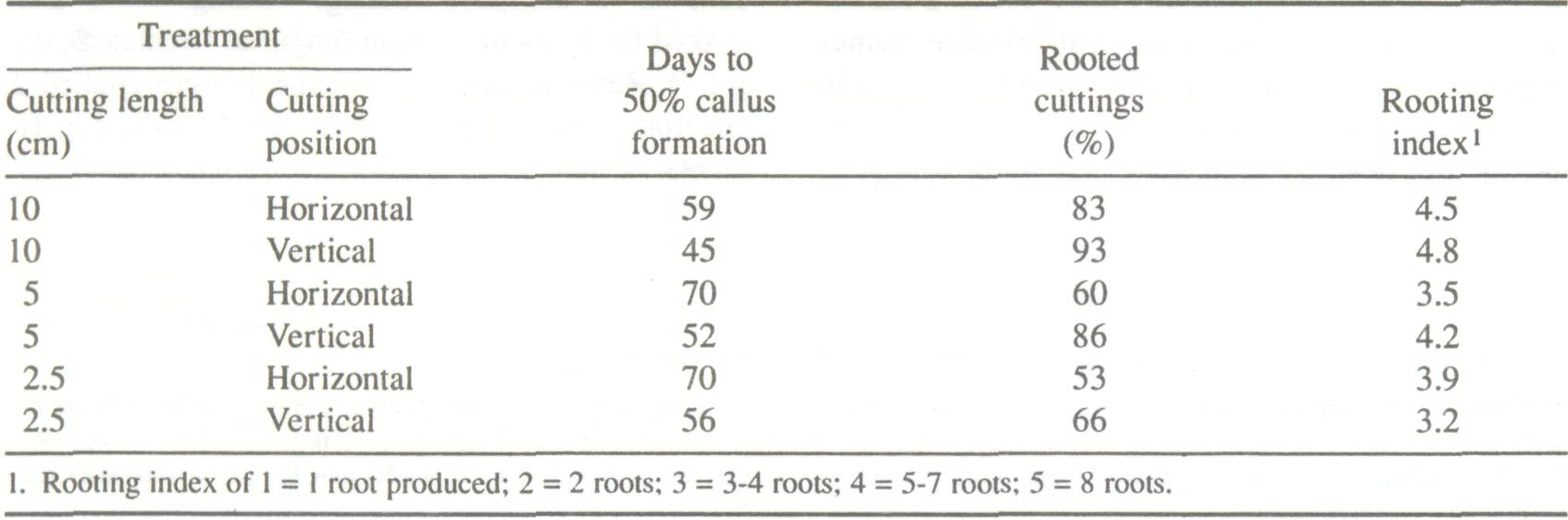
Root Emergence Root emergence of branch cuttings occured after 2.5-5 months. Rooting rates were greater with cuttings taken from the basal part of shoots or branches. There was no relation between rooting and original position of cuttings in the canopy. We noticed that cutting quality and sanitation affected rooting rate greatly. There was a moderate correlation between rooting and cutting diameter (within the range of 4-9 mm) as well provenance of the cutting. Cuttings were often attacked by unknown stem-boring insects. For root cuttings, callus formation occurred on 50% of the cuttings after 45-70 days. Callus formed quickest on cuttings placed vertically in the medium. With this treatment, 50% of the cuttings sprouted stems between 45-56 days. Root cuttings 10 cm long budded faster than cuttings 5 and 2.5 cm in length. Root cuttings 10-cm long and planted vertically produced the highest number of roots per cutting (7). Ninety-three percent of these cuttings rooted after 3 months, versus only 53% for cuttings 2.5 cm long and planted horizontally. Table 1 shows the results for all treatments. In the same trial, a sand:compost mixture (2:1) was compared with a pure sand medium. There was no difference in effect on rooting between the two media, however, nodule counts were higher on cuttings grown in pure sand. Optimum Period for Collecting Cuttings The optimal period for collecting cuttings from stump sprouts was between June and September, which coincided with maximum leaf fall. Rooting rates varied between 25 and 32%. The highest rooting rates for cuttings from branches of adult trees occurred between the end of defoliation and the beginning of foliation as follows: 27% in June; 17% in August; and 24% in September (Tolkamp 1990). Rooting Medium Balima (1989) conducted a study aimed at determining the type of substrate that best enhances rooting in cuttings. Seven media consisting of various mixtures of sand and compost were tested with a randomized complete block design with 4 replications. Plots consisted of 40 cuttings from trees more than 1-year old collected on 12 Jun 1989. After eight weeks average rooting rates ranged from 3.3 to 23.3% for the treatments. No significant differences were observed between average rates of root elongation for the different treatments. However, the 2:1 sand:compost mixture showed the best rooting percentage (23.3%), and had relatively more roots per cutting than the others. This medium also had a pH of 7.1, higher than the optimum reported in the literature (MacDonald 1986). Table 1. Effect of cutting length (cm) and position on rooting of branch cuttings of Faidherbia albida, CNSF, Burkina Faso, 1989.
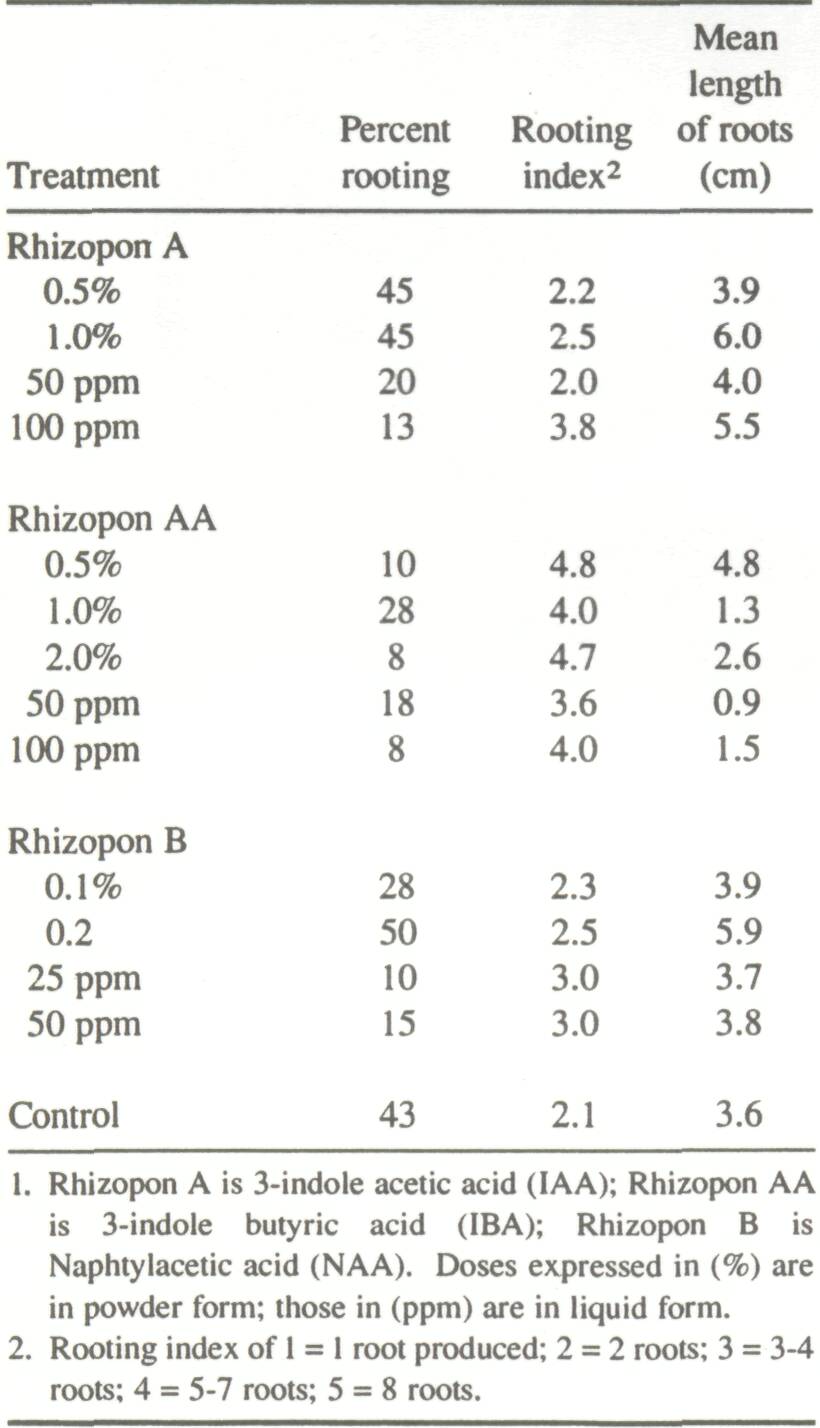
A trial was carried out in 1989 to compare 13 hormone treatments and a no-hormone control on rooting of shoot cuttings of F. albida (Balima 1989). Seven of the treatments werein powder form and six were in liquid form. A randomized complete block design with four replications was used. For each treatment, 40 cuttings were planted in a medium of two parts river sand and one part compost. None of the hormone treatments had better root emergence than the control. However, Rhizopon AA (indole-butyric acid or IBA) had more roots per cutting, and longer and more fibrous roots than the control and other treatments (Table 2). Several hormone treatment, including several with IBA, showed improvement in average root length over control (Nikiema and De Fraiture 1989).
Temperature Requirements Nikiéma and De Fraiture (1989) demonstrated that favorable temperatures for rooting ranged from 15-300C. In order to control temperature, CNSF utilizes 'Norten' shade screen which reduce sunlight exposure by 40%. We found that thatch made of reed mats can lower temperature by 2-5*C. Humidity Cuttings must remain turgid from the time of collection to planting. Humidity control throughout this period is critical. Besides the double-enclosed mini-greenhouses described earlier, we mist the environment 2-4 times a day to keep both the substrate and air saturated. We use the presence or absence of water droplets on the mini-greenhouse panels to determine if more mist is needed. Phytosanitary Problems Fungus attacks on cuttings are a common problem. Soaking cuttings in Benlate® (0.5 g L-1) before planting and irrigating the rooting medium with the same mixture is effective. Before planting, cuttings should be stripped of leaves to prevent them from rotting. Two weeks after planting, cuttings are sprayed with Benlate® solution on a weekly basis. Hardening Rooting rates and root development from different material can vary greatly. Rooting of branch cuttings from adult trees occurs after about 2-3 months and much earlier for cuttings from young growth. Sudden outplantings of cuttings results in stress and mortality. A method by which cuttings can be slowly and gradually hardened is needed.
Balima, R. 1989. Etude des conditions optimales de bouturage d'Acacia albida. Thesis, Institut de développement rural (IDR), Ouagadougou, Burkina Faso. De Fraiture, A., and Nikiéma, A. 1989. Mise au point de techniques de bouturage sous chassis des racines d'Acacia albida Del. Technical Internal Report, Ouagadougou, Burkina Faso: Centre national de semences forestieres. 16 pp. (Limited distribution.) MacDonald, B. 1986. Practical woody plant propagation for nursey growers. Portland, Oregon, USA: Timber Press. 669 pp. Nikiéma, A., and De Fraiture, A. 1989. Mise au point de techniques de bouturage sous chassis d'Acacia albida Del. Internal technical report. Ouagadougou, Burkina Faso: Centre national des semences forestières. (Limited distribution.) Tolkamp, G.W. 1990. La production d'Acacia albida par bouturage. Internal report. Ouagadougou, Burkina Faso: Centre national des semences forestières. (Limited distribution.)
1 Centre national de semences forestieres (CNSF), 01 B.P. 2682, Ouagadougou, Burkina Faso. Nikiema, A., and Tolkamp, G.W. 1992. Propagation of Faidherbia albida by cuttings: experience of the National Forest Seed Center. Pages 97-100 in Faidherbia albida in the West African semi-arid tropics: proceedings of a workshop, 22-26 Apr 1991, Niamey, Niger (Vandenbeldt, R.J., ed.). Patancheru, A.P. 502 324, India: International Crops Research Institute for the Semi-Arid Tropics: and Nairobi, Kenya: International Centre for Research in Agroforestry. |