An e-publication by the World Agroforestry Centre
METEOROLOGY AND AGROFORESTRY

|
|
An e-publication by the World Agroforestry Centre |
|
METEOROLOGY AND AGROFORESTRY |
|
|
section 3 : Regional examples The influence of rainfall distribution to traditional agroforestry practices in western Kenya B.R. K. Shuma, P.M. Mung'ala
Kenya Woodfuel Development Programme Introduction The Kenya Woodfuel Development Programme (KWDP) is a research and development implementation programme whose mandate is to contribute towards helping farmers to plant trees on their farms for self- sufficiency in fuelwood, among other benefits. The districts of Kakamega, Kisii, Murang'a and Nakuru were identified for the programme activities because of their high population and agricultural potential. KWDP, which works under the auspices of the Ministry of Energy and Regional Development (MOERD), was initiated in 1983 following the recommendations of the Kenya Fuel-wood Cycle Study (1980-82). This study was carried out jointly by the Ministry and the Beijer Institute of the Swedish Royal Academy of Sciences. KWDP is financed through a Dutch Government grant for its programmes in Kakamega and Kisii Districts where ground activities started in 1984 and 1985, respectively. The Programme's approach towards district implementation programmes is both holistic and step-wise in nature, whereby in the first step, the district's resources, including physiological, climatic, socio-cultural, demographic and other relevant information, are inventoried to assist in realistic planning-implementation strategies. It was during this survey that the KWDP learned a great deal from farmers' knowledge tree regeneration practices in Kakamega District. One of the study's important findings was that the highlands would experience serious fuelwood scarcity earlier than projected because the rising populations would necessitate rapid land demarcation and privatization. This brief paper will highlight KWDP's findings on rainfall distribution and its effects on traditional agroforestry practices within the district. The KWDP has indeed used the information from the findings and the observed traditional agroforestry activities and has incorporated such knowledge in its planning strategies for the Kakamega District. The main advantage of incorporating local farmers' knowledge in any planned implementation activities is that such planned activities are both realistic and acceptable to the farmers.
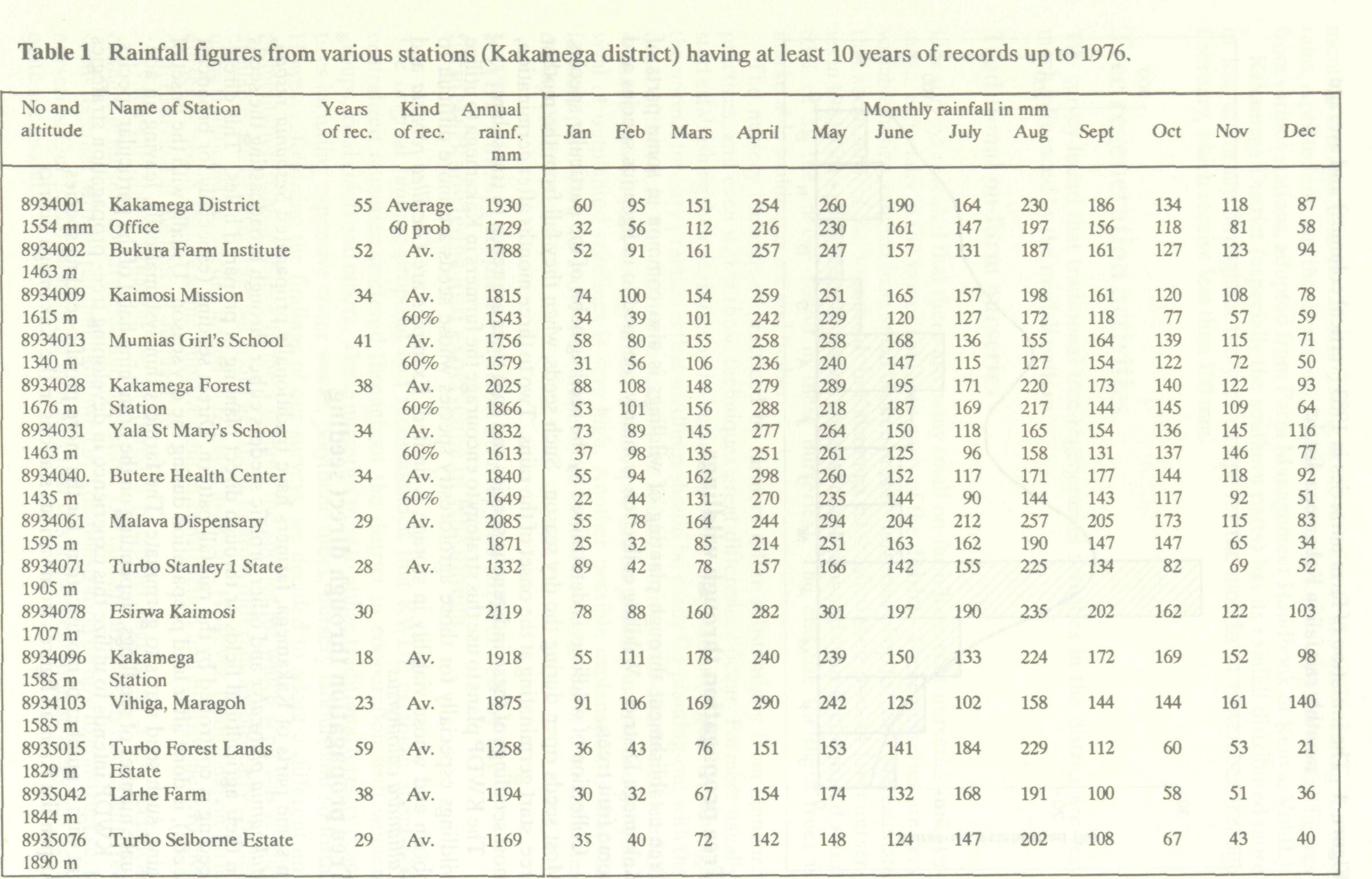
The average annual rainfall for Kakamega District varies from 1,200 mm to over 2,000 mm, the annual rainfall increasing from the drier northern parts of the district to the much wetter southern areas. Most of this rain occurs between March and October with monthly averages of over 120 mm during those months. Peaks occur during the long rains, April to June, and the short rains, August to October. (See App. for rainfall figures from various stations, adopted from Farm Management Handbook of Kenya, Vol.11.) Kakamega District (especially the southern parts) has its rainfall distributed more or less uniformly throughout the year except for the months of November through February, which receive less than 100 mm.
The survey found that traditional tree-regeneration activities in the district are very much influenced by the rainfall pattern.
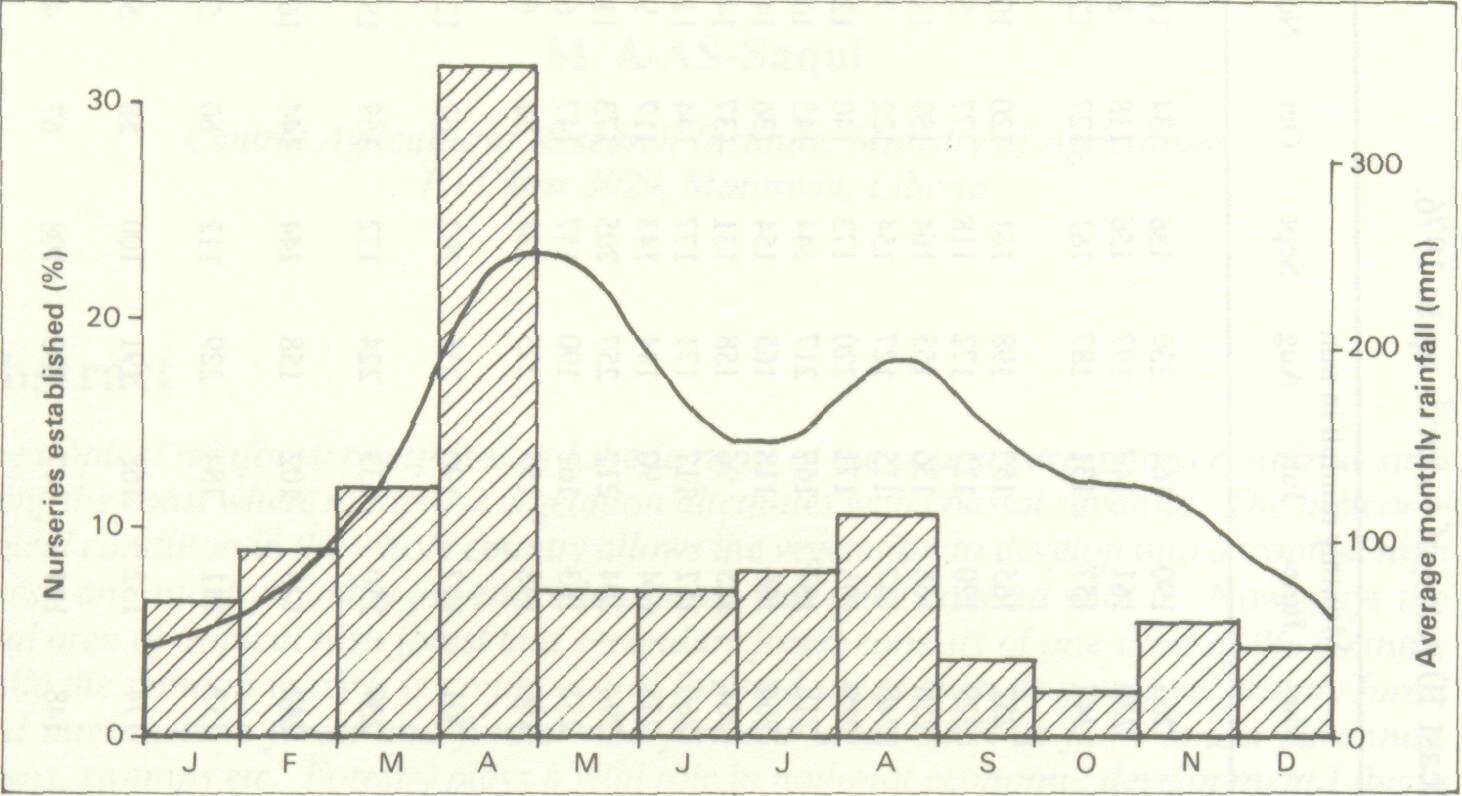
Our surveys revealed that there are many small on-farm bare-root nurseries in Kakamega, especially in the wetter southern parts of the district. These nurseries are very variable in size, ranging from small broken pots to nurseries of up to 3 m2. We estimate that about 40% of the households in Kakamega established their own on-farm nurseries in 1983 with a preference for exotic species (eucalyptus and cypress comprised about 83% of all the species found in these nurseries). The end use for these trees is marketable building poles and timber. The nursery techniques practiced by farmers differ substantially from standard practices, and even within those techniques great differences occur. Farmers usually start establishing their nurseries at the beginning of the rainy season (Figure 1), although the normal forestry practice is that seedlings should be ready for planting-out with the onset of the rains. The district (especially the south) receives well-distributed rainfall, so that even with seed-sowing in March and April and outplanting in June and July, survival of outplanted seedlings is very high. Another possible explanation is that the farmers plant early to avoid the cumbersome task of having to water their nurseries during the dry months.
The original funding proposal had recommended that KWDP establish about 600 centralized nurseries scattered throughout the district in cooperation with women groups, local chiefs and others. These nurseries were to utilize traditional forestry practices including expensive water works, polythene tubes, nursery labour, and so forth. However, following the findings of our surveys, we decided to adopt a different implementation strategy. Since farmers planted the species for which seed was readily available, we believed that we could get them to grow different agroforestry species using traditional knowledge if seed were made available. However, traditional on-farm nurseries would require some improvement in construction and management to give better survival at the time of outplanting. Given the above situation, we prepared a pamphlet suggesting a few technical changes in nursery construction and operation. The farmers are initially issued with free seeds together with the pamphlet followed by a demonstration on how to construct such nurseries. Our initial monitoring indicates that this implementation strategy has been quite successful.
Tree establishment through planting of wildlings is also common in some parts of Kakamega District. Wildling collection is mainly confined to indigenous species and some fruit trees. Collection of wildlings is determined by the seeding habit of the particular species. Most seeds ripen during the dry season. Such seeds, when they fall from the mother tree, start germinating at the onset of the rains. Two to three months after germination, most seedlings of these indigenous species and fruit trees are ready to transplant. The KWDP plans to use this strategy to encourage the farmers in Kakamega to utilize wildlings especially for those agroforestry species whose seeds are more difficult to obtain and whose viability in storage is limited. Examples are Grevillea robusta and Calliandra calothyrsus.
In some parts of Kakamega, farmers have traditionally propagated Sesbania sesban, Makhamia platycalyx and other prolific seeders either through broadcasting the seeds on their agricultural fields or through direct planting in prepared holes. This direct-seeding is controlled by the rainfall pattern. Direct seeding (especially for broadcast seeds), is done after land preparation during the dry season. Usually with the onset of rains, such seed starts to germinate. The farmers thin systematically, leaving an adequate number of seedlings, depending on the branching habit of the particular species. KWDP intends to utilize this experience in developing tree- propagation strategies but with a number of modifications for the more prolific-seeding species. Appendix: Rainfall figures from various stations in the Kakamega district
|