An e-publication by the World Agroforestry Centre
AGROFORESTRY IN THE HIGHLANDS OF EASTERN AND CENTRAL AFRICA


|
|
An e-publication by the World Agroforestry Centre |
|
AGROFORESTRY IN THE HIGHLANDS OF EASTERN AND CENTRAL AFRICA
|
|
|
5. REGIONAL NETWORK DEVELOPMENT AND SUPPORT ISSUES 5.2 CAAFIN: Central Africa Agroforestry Information Network (J-M. Pennes) Background In Eastern and Central Africa, development projects, governmental organizations, NGO's and others aim at promoting agroforestry technologies. A large number of studies on land-use systems in Central Africa highlands clearly demonstrate potential advantages of agroforestry technologies, addressing crucial problems such as soil erosion, soil fertility improvement, production of fodder, fuelwood or timber, mulch for cash crops, etc. For example, hedgerow intercropping, contour hedges, fodder banks or improved fallows are potential answers which already appear as priority research items, in many parts of the world. ICRAF, through its Agroforestry Research Networks (AFRENA), works in strong collaboration with national agricultural and forestry research institutions in agroforestry research, training, information and dissemination activities. The East Africa AFRENA works in collaboration with ISABU in Burundi and ISAR in Rwanda. Linking national and international institutions is crucial for impact, adoption and sustainability of proposed agroforestry technologies. For this to work well, relevant and easily accessible documentation is essential. Because of its multidisciplinary approach, agroforestry research would benefit greatly from documentation support. ICRAF, through its Information & Documentation programme aims at strengthening agroforestry information systems in the national research institutions. This strategy was started in 1992 in West Africa by creating the AFRENA/SALWA information sub-network - an information exchange network that works with selected national institutes and existing regional capacities (e.g. RESADOC). The aim is to propose the creation of a similar network - the Central Africa Agroforestry Information Network (CAAFIN) - linking ICRAF and Central Africa Francophone countries, namely Burundi, Rwanda and Zaire. Although some of the research centres in these countries have been operational for more than ten years, dissemination of results still needs strengthening. The idea of establishing a network started in april 1993 during a visit to the three countries in order to identify potential partners among national research and education institutes (see Annex 1). Three activities were carried out:
Above actions aimed at implementing (or reinforcing in some cases) information exchange programme between ICRAF and centres, as well as between centres themselves. Educational and research institutions visited in Burundi and Rwanda were very interested in becoming a partner of this network. Most of them are already working on improving the management of their existing documentation (by computers acquisition) and human resource training at the national level. Existing documentation is voluminous (mainly French grey literature) and would rapidly and easily enrich the network database. Concerning the schools and Universities, teaching Agronomy and Forestry education, it is important to note that Agroforestry is to become a major subject in the education programmes in Burundi as well as in Rwanda. ICRAF Training, and the recently established Education, programme will provide support to educational programmes in the following institutions: ISA Gitega, ITAB Karuzi, FACAGRO Bujumbura, UNR Butare. The collection and dissemination of agroforestry information does not require heavy investments in terms of infrastructure, material and computers. The presence of highly motivated potential partners from the research institutes would facilitate the improvement of quality and quantity of scientific publication through the information network in a relatively short time.
The proposed objectives are to:
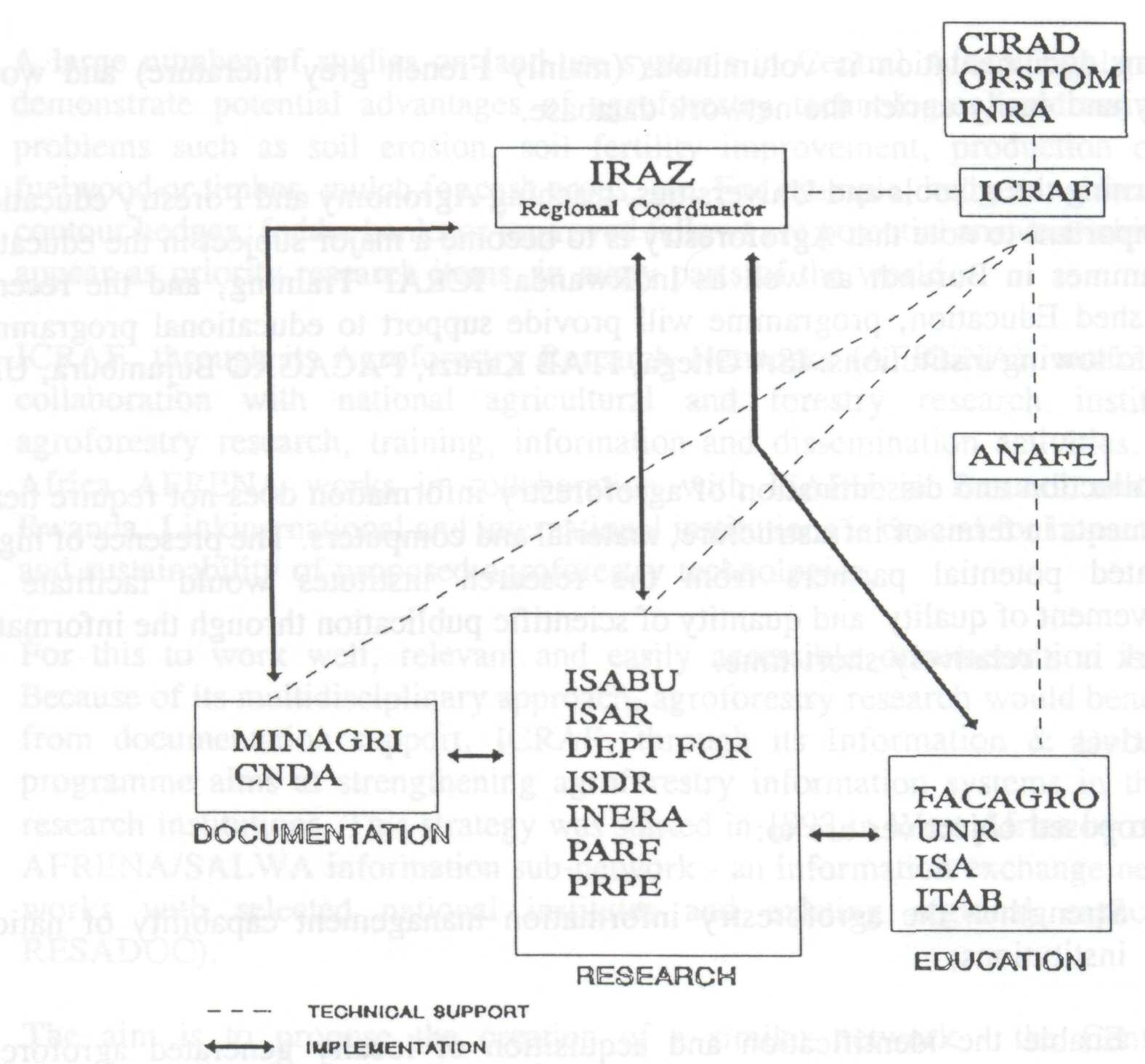
Methodology Although ICRAF will be supplying administrative and technical support to the project, the regional coordinating centre will be responsible for planning and regulating information exchange flow, in terms of quantity as well as quality. National institutions will be sharing responsibilities for collection, analysis, codification of agroforestry documentation, databases management, dissemination processes, communication, human resources involvement, etc. To illustrate this strategy, the following figure shows how the national, regional and international institutions could interact.
The collaboration between CAAFIN and ANAFE networks will enable educational institutions interested in agroforestry to collaborate and co-ordinate their actions so as to improve the contents and delivery of agroforestry education.
Following successful completion of the first phase, it is proposed that a long term cooperation be established, with the following components:
Expected Outputs The outputs of the network will be:
Users and Beneficiaries This initiative should have a stimulating effect on researchers, technicians and extension agents by making their work less "anonymous". Educational institutions involved in agroforestry will benefit from this initiative which will facilitate interdisciplinary collaboration, exchange of information, teaching material and staff. The farmers will obviously be the ultimate beneficiaries of this improvement as they will be advised by better informed extension agents.
ICRAF Information and Documentation unit will coordinate the network, in terms of agreements made with technical and financial partners. ICRAF will be responsible for the following :
Annex 1: List of visited institutions Burundi: 13-25 April 1993 Ministère de I'Agriculture et de I'Elevage, Direction de la Planification Agricole, BP 1850, Bujumbura Institut des Sciences Agronomiques du Burundi (ISABU), BP 795, Bujumbura Faculte" d'Agronomic (FACAGRO), BP 2940, Bujumbura Département des Forêts, Ministère de I'Aménagement, du Tourisme et de I'Environnement, BP 631, Bujumbura (DEPTFOR) Institut Supérieur d'Agriculture (ISA), BP 1, Gitega Institut de Recherche Agronomique et Zootechnique (I.R.A.Z.), BP 91, Gitega Institut Technique Agricole du Burundi (ITAB), BP 129, Karuzi ICRAF/ISABU, BP 173, Gitega PRPE/ISABU (FAC), Projet de Recherche pour la Protection de 1'Environnement, BP 1190, Bujumbura
Directuer de I'Environnement, MINETO, Projet Aménagement et Développement, BP 46, Kigali MINAGRI, (CNDA), BP 621, Kigali USAID, BP 28, Kigali INADES - Formation, BP 866, Kigali Universite Nationale du Rwanda/Faculté des Sciences Agronomiques, BP 117, Butare (UNR) Ecole Agricole et Vétérinaire de Kabutare (EAVK), BP 119, Butare PARF/ISAR Forestry and Agroforestry Research Project (Coopération Suisse), Institut des Sciences Agronomiques du Rwanda (ISAR), Ruhande, BP 617, Butare ICRAF/ISAR, Ruhande, BP 617, Butare ISAR Rubona, BP 138, Butare Direction des Forêts, Minagri, BP 621, Kigali Representation FAO, Kigali |